

Choosing the right private aviation solution is a critical financial and logistical decision for high-net-worth individuals and corporate executives. According to the National Business Aviation Association, the private aviation market is projected to grow by 4.2% annually through 2028, driven by demand for flexible and efficient travel options. Understanding the nuances between chartering and jet cards is essential to optimizing your travel budget and schedule. This guide breaks down the key differences to help you make an informed choice.
Understanding Private Jet Charter
Private jet charter is a pay-as-you-go model where you rent an entire aircraft for a specific trip. This is the most traditional form of private aviation. You book a flight, and the operator provides the aircraft, crew, and handling services for that single journey. Charter is ideal for occasional travelers who do not fly frequently enough to justify a larger upfront commitment.
How Charter Pricing Works
Charter rates are typically calculated based on the aircraft type, flight hours, and distance. The cost can fluctuate based on market demand, positioning fees, and seasonal peaks. For example, flying during major holidays or in peak summer months can result in higher rates due to increased demand. Zephyr Jets provides transparent charter quotes that include all necessary fees, ensuring no hidden costs. You can explore our charter services to get a personalized quote for your next trip.
Benefits of Chartering
The primary benefit of chartering is flexibility. You can choose from a wide variety of aircraft types, from light jets for short hops to heavy jets for long-haul international flights. This allows you to select the perfect plane for your specific needs, whether it is cargo space, passenger comfort, or range. Additionally, there is no long-term commitment, making it a low-risk option for first-time private flyers.
What is a Jet Card?
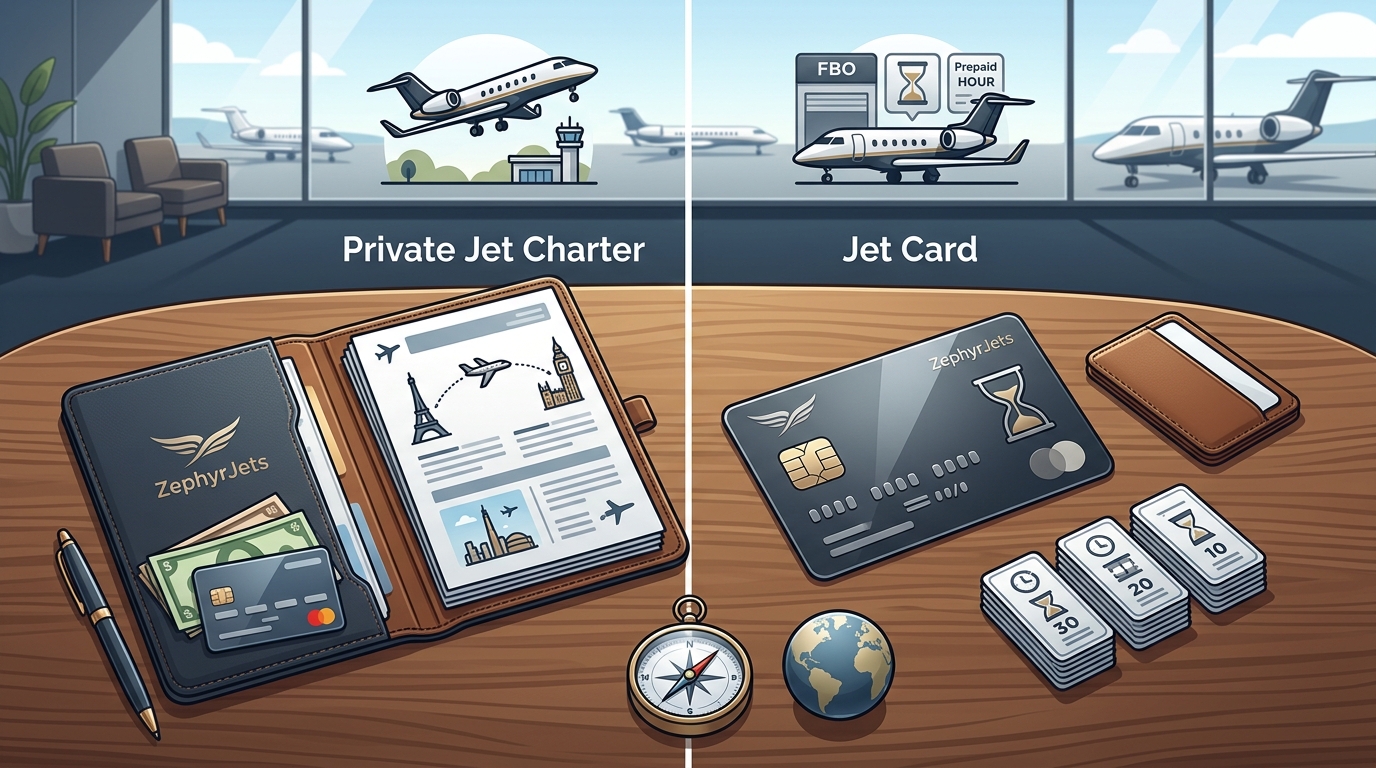
A jet card is a prepaid program that guarantees access to private aviation services. When you purchase a jet card, you buy a block of flight hours at a fixed hourly rate. This model offers more predictability than chartering. A jet card is a prepaid financial instrument that provides guaranteed availability and fixed pricing for private jet flights within a specified network.
How Jet Cards Work
When you buy a jet card, you deposit a lump sum of money. As you fly, the cost is deducted from your balance at the agreed-upon hourly rate. Most jet card programs require a minimum purchase, often starting at 25 to 50 hours. This ensures that you have enough credit to cover your travel needs for a significant period. You can learn more about our jet card program and how it can streamline your travel planning.
Benefits of Jet Cards
The main advantage of a jet card is price stability. Unlike charter rates, which can spike during high-demand periods, jet card rates are fixed for the duration of your contract. This protects you from market volatility. Additionally, jet card holders often receive priority booking status, ensuring that aircraft are available when you need them. This is particularly valuable for business travelers who cannot afford delays.
Cost Comparison: Charter vs. Jet Card
Understanding the cost structure is crucial for making the right choice. Charter rates are variable, while jet card rates are fixed. Here is a breakdown of the financial implications of each model.
| Feature | Private Jet Charter | Jet Card |
|---|---|---|
| Pricing Model | Variable, per-trip cost | Fixed hourly rate |
| Upfront Cost | None | High (prepaid block of hours) |
| Price Stability | Low (subject to market demand) | High (locked in for contract term) |
| Best For | Infrequent travelers | Regular travelers (25+ hours/year) |
| Availability | Depends on aircraft availability | Guaranteed (with proper notice) |
According to industry data from the Aviation Week Network, jet card holders typically save between 10% and 20% on annual travel costs compared to chartering, provided they fly at least 50 hours per year. This savings comes from the elimination of market-driven price surges. For more insights on aviation economics, you can read Aviation Week's analysis on private jet trends.
Flexibility and Availability
Flexibility is a key differentiator between charter and jet cards. Chartering offers the widest selection of aircraft, as you can book any available plane in the market. However, availability is not guaranteed, especially during peak times. Jet cards, on the other hand, offer guaranteed availability, but you are limited to the aircraft types within the card's network.
Booking Lead Times
Charter bookings can be made with very short notice, sometimes as little as a few hours. This is ideal for last-minute business needs. Jet cards also offer quick booking, but the guaranteed availability usually requires 24 to 48 hours' notice. This allows the operator to position the aircraft appropriately. Zephyr Jets ensures that both charter and jet card clients receive prompt and reliable service. Check our about page to learn more about our commitment to reliability.
Aircraft Selection
With chartering, you have the freedom to choose the exact aircraft that fits your needs. If you need extra cargo space for a medical shipment, you can book a heavy jet. If you are traveling with a small team, a light jet is more cost-effective. Jet cards often have a defined fleet, which may limit your choices. However, most premium jet card programs, including those offered by Zephyr Jets, provide a wide range of aircraft options within their network.
Ideal Use Cases for Each Model
Choosing between charter and a jet card depends on your travel patterns. Here are some scenarios where each model shines.
When to Choose Charter
Charter is best for individuals or companies that fly less than 25 hours per year. If your travel is sporadic or unpredictable, chartering avoids the high upfront cost of a jet card. It is also ideal for unique trips that require specific aircraft types not available in a standard jet card network. For example, if you need a long-range jet for a trip to Asia, chartering gives you the flexibility to select the right plane. Learn more about our long-range charter capabilities.
When to Choose a Jet Card
A jet card is ideal for frequent travelers who fly at least 50 hours per year. If you have a predictable travel schedule, a jet card offers cost savings and peace of mind. It is also perfect for businesses that need to manage travel budgets tightly. The fixed hourly rate makes it easier to forecast expenses. Additionally, jet card holders often enjoy priority customer service and dedicated support. Explore our contact page to discuss your specific needs.
Key Takeaways
- Charter is Pay-As-You-Go: Ideal for infrequent travelers with unpredictable schedules.
- Jet Cards Offer Fixed Rates: Best for frequent flyers seeking budget predictability.
- Upfront Costs Differ: Jet cards require a significant initial deposit, while chartering does not.
- Availability Guarantees: Jet cards provide guaranteed aircraft availability with proper notice.
- Aircraft Selection: Chartering offers the widest choice of aircraft types.
- Cost Savings: Jet card holders can save 10-20% annually compared to chartering for high-volume users.
- Flexibility vs. Stability: Charter offers flexibility, while jet cards offer financial stability.
Frequently Asked Questions
What is the minimum purchase for a jet card?
Most jet card programs, including those at Zephyr Jets, require a minimum purchase of 25 to 50 flight hours. This ensures that you have enough credit to benefit from the program's advantages.
Can I upgrade my aircraft when chartering?
Yes, chartering allows you to upgrade or downgrade your aircraft based on availability and your specific needs. This flexibility is one of the key benefits of the charter model.
How far in advance do I need to book a jet card flight?
Jet card holders typically need to provide 24 to 48 hours' notice to guarantee aircraft availability. This allows the operator to position the aircraft and prepare for your trip.
Are jet card rates fixed for the life of the contract?
Jet card rates are usually fixed for a period of one to three years. After that, the rates may be adjusted based on market conditions, but you will be notified in advance.
What happens if I do not use all my jet card hours?
Unused hours in a jet card program typically do not expire immediately. However, policies vary by provider. Zephyr Jets offers flexible terms to ensure you get the most value from your investment.
Is chartering more expensive than a jet card?
For occasional travelers, chartering is often more cost-effective because it avoids the high upfront cost of a jet card. For frequent travelers, jet cards usually offer better value due to fixed rates and priority access.
Can I use a jet card for international flights?
Yes, most jet card programs can be used for international flights, provided the aircraft is available and the necessary permits are secured. Zephyr Jets supports global travel for both charter and jet card clients.
Ready to Elevate Your Travel?
Whether you choose the flexibility of chartering or the stability of a jet card, Zephyr Jets is here to provide exceptional service. Our team of experts is ready to help you find the perfect solution for your travel needs. Contact us today to get a personalized quote or to learn more about our jet card program. Visit our contact page to start your journey with Zephyr Jets.