

Private aviation costs have shifted dramatically in the post-pandemic era, with industry data showing a significant increase in operational overheads and fuel volatility. According to recent aviation market reports, the average cost per flight hour for light jets has risen by approximately 15% since 2021 due to supply chain constraints and increased demand. Understanding these financial dynamics is critical for executives and family offices who must balance flexibility with fiscal responsibility. This analysis dissects the primary financial models available in the current market, evaluating their suitability for different travel frequencies and budget structures. (About Us Zephyr Jets)
Core Charter Pricing Structures
On-demand chartering remains the most accessible entry point into private aviation. This model operates on a pay-per-flight basis, offering maximum flexibility for travelers with irregular schedules. The pricing is typically calculated using a hourly rate multiplied by the flight time, plus additional operational fees. (Private Jet Charter Flights)
Hourly Rate Dynamics
Hourly rates vary significantly based on aircraft category. Light jets, such as the Citation CJ3 or Phenom 300, generally command rates between $3,500 and $4,500 per hour. Midsize jets, including the Hawker 800 or Citation XLS, range from $5,000 to $7,000 per hour. Heavy jets like the Gulfstream G450 or Falcon 7X can exceed $10,000 per hour. These rates are influenced by market demand, positioning costs, and seasonal peaks. (Blog Zephyr Jets)
Positioning and Deadhead Fees
A critical component of on-demand pricing is the positioning fee. If an aircraft must fly from its home base to your departure airport, you pay for those hours. According to industry standards, positioning costs can add 20% to 40% to the total trip cost for short-haul flights. This makes on-demand charter less economical for frequent, short-distance travel where the aircraft is already positioned at the departure airport. (Air Ambulance Charter Medical)
Minimum Flight Hours
Most operators enforce a minimum flight hour requirement, typically ranging from 1.5 to 2.0 hours. This ensures that the operational cost of preparing the aircraft covers the revenue generated. For short trips, this minimum can inflate the effective hourly rate, making it less competitive compared to other models for frequent travelers.
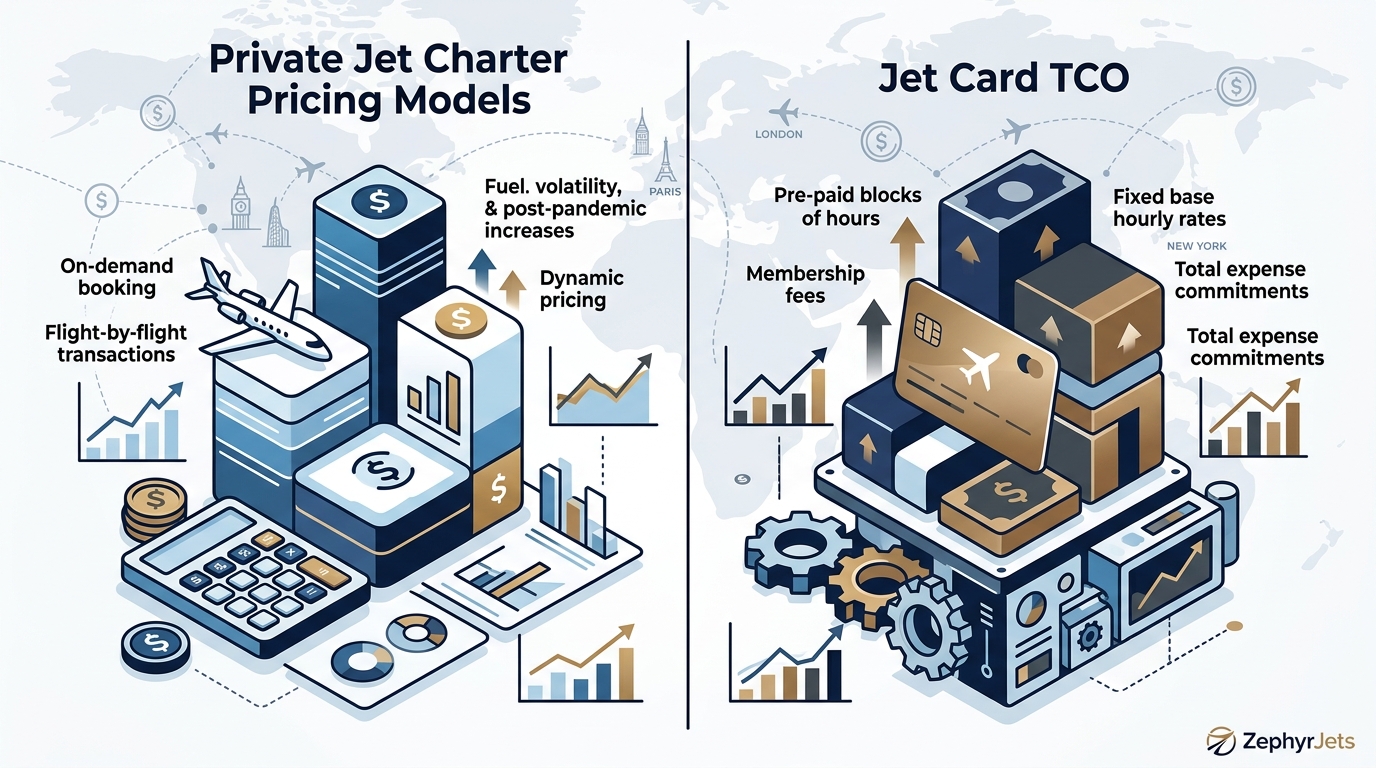
The Jet Card Financial Framework
A jet card is a prepaid instrument that guarantees access to private aircraft for a set number of hours. It bridges the gap between on-demand charter and fractional ownership, offering predictable pricing without the capital expenditure of ownership.
Prepaid Hour Blocks
Jet cards are sold in blocks of hours, commonly starting at 25 hours. The price per hour is fixed at the time of purchase, protecting the buyer from fuel surcharges and market volatility for the duration of the card's validity. This predictability is a primary driver for corporate travel managers who need to forecast expenses accurately.
Deposit and Monthly Fees
Most jet card programs require a substantial deposit, often ranging from $100,000 to $250,000, which is refundable upon card cancellation. Additionally, monthly management fees apply, typically between $1,000 and $2,500, covering administrative oversight, insurance, and customer support. These fixed costs must be factored into the total cost of ownership calculation.
Cancellation Policies
Liquidity is a key consideration. Jet card contracts usually include a cancellation notice period, often 24 to 48 hours, and may impose penalties for early termination. Understanding these terms is essential for maintaining financial flexibility. Zephyr Jets advises clients to review these clauses carefully to ensure alignment with their travel unpredictability.
Membership vs. Card Economics
While jet cards offer prepaid certainty, membership programs provide a different value proposition. These programs often combine the benefits of a jet card with the flexibility of on-demand charter, sometimes including access to a broader network of aircraft.
Hybrid Pricing Models
Some membership programs utilize a hybrid model where the hourly rate is lower than standard jet cards but includes annual dues. This structure can be more cost-effective for travelers who fly between 50 and 100 hours annually. The lower hourly rate compensates for the annual commitment, offering a middle ground between the high deposit of a jet card and the variable costs of on-demand charter.
Network Access and Availability
Membership programs often provide access to a wider range of aircraft types, including heavy jets and ultra-long-range aircraft, which may be restricted in standard jet card programs. This flexibility is crucial for international travel or large group missions. According to aviation industry analysts, members of hybrid programs report higher satisfaction rates due to the ability to secure larger aircraft for special occasions.
Operational Transparency
Transparency in pricing is a hallmark of reputable brokers. Zephyr Jets provides itemized quotes that break down every cost component, from fuel to landing fees. This level of detail allows clients to compare the true cost of different models accurately. Hidden fees are a common pitfall in less transparent programs, making clear communication a vital factor in model selection.
Empty Leg Cost Optimization
Empty legs, or repositioning flights, occur when an aircraft needs to fly without passengers to its next pickup location. These flights are offered at significantly discounted rates, often up to 75% off the standard charter price. This strategy is ideal for flexible travelers who can adapt their schedules to available aircraft positions.
Availability and Flexibility
Empty legs are not guaranteed and can be canceled with short notice. They are most prevalent during seasonal transitions, such as the move from European summer bases to North American winter bases. Travelers who prioritize cost savings over schedule certainty can achieve substantial savings through this method.
Strategic Booking
Monitoring empty leg lists requires diligence. Zephyr Jets maintains a daily updated list of available empty legs, allowing clients to identify opportunities that match their travel needs. By leveraging these opportunities, travelers can access heavy jets and ultra-long-range aircraft at prices comparable to light jet charter rates.
Limitations and Risks
The primary limitation of empty legs is the lack of control over timing and routing. If a client's schedule is rigid, the risk of last-minute changes may outweigh the cost benefits. It is essential to have contingency plans in place, such as backup commercial flights or alternative private options.
Total Cost of Ownership Variables
Evaluating the total cost of ownership (TCO) requires looking beyond the headline hourly rate. Several variable costs can significantly impact the final expense of private aviation.
Fuel Surcharges
Fuel is a major component of private jet costs. On-demand charters often include fuel surcharges that fluctuate with market prices. Jet cards typically lock in fuel costs at the time of purchase, providing protection against volatility. For long-term travelers, this predictability can result in significant savings during periods of high fuel prices.
Landing and Handling Fees
Landing fees vary by airport and are based on the aircraft's weight. Handling fees, which cover ground services such as parking, security, and catering coordination, can also vary widely. International flights often incur higher handling fees due to customs and immigration processing. These costs are typically passed through to the client and should be included in TCO calculations.
Catering and Amenities
While basic catering is often included, premium catering options and special amenities can add to the cost. Some jet card programs include a set amount of catering credits, while others charge per item. Understanding these inclusions helps in comparing the true value of different programs.
Insurance and Security
Insurance costs are embedded in the hourly rate or membership dues. However, additional security measures, such as armored vehicles or secure ground transportation, may incur extra fees. For high-profile clients, these security costs are a necessary part of the TCO.
Key Takeaways
- On-Demand Flexibility: Ideal for irregular travel, with rates starting from $9,500 for light jets on short routes like Los Angeles to Las Vegas.
- Jet Card Predictability: Best for frequent travelers (25+ hours/year), offering fixed hourly rates and protection against fuel volatility.
- Empty Leg Savings: Can offer discounts up to 75% for flexible travelers, providing access to heavy jets at light jet prices.
- TCO Complexity: Total cost includes positioning fees, landing charges, and handling fees, which can add 20-40% to base rates.
- Broker Value: Experienced brokers like Zephyr Jets leverage 16+ years of industry expertise to secure competitive rates and vetted operators.
- Transparency is Critical: Itemized quotes prevent hidden fees and allow for accurate comparison between charter, card, and membership models.
- Operational Grit: The ability to manage AOG (Aircraft on Ground) situations and customs delays is a key differentiator in service quality.
Frequently Asked Questions
What is the difference between a jet card and a jet membership?
A jet card is a prepaid instrument for a specific number of hours with a fixed rate, while a jet membership often combines prepaid hours with annual dues and access to a broader network of aircraft types, including heavy jets.
How much does it cost to charter a private jet from New York to London?
Chartering a heavy jet from New York to London typically costs between $110,000 and $150,000, depending on the specific aircraft model and current market conditions. This route requires an ultra-long-range aircraft for a direct flight.
Are empty leg flights reliable for business travel?
Empty legs are less reliable for critical business travel due to the risk of last-minute cancellation. They are best suited for flexible leisure travel or when backup plans are in place.
What is the minimum flight hour for on-demand charter?
Most operators enforce a minimum flight hour of 1.5 to 2.0 hours. This ensures that the operational costs of preparing the aircraft are covered by the revenue generated.
How does Zephyr Jets ensure operator safety?
Zephyr Jets only works with ARGUS and Wyvern-rated FAA Part 135 operators. This rigorous vetting process ensures that all aircraft meet the highest safety and maintenance standards.
What are the hidden costs in private jet chartering?
Hidden costs can include positioning fees, landing fees, handling charges, and fuel surcharges. Zephyr Jets provides transparent, itemized quotes to eliminate surprises.
Can I book a medical air ambulance through Zephyr Jets?
Yes, Zephyr Jets arranges medical air ambulance charters for planned and time-sensitive patient transfers, coordinating with specialized medical transport providers.
Contact Zephyr Jets
Choosing the right private aviation model requires expert guidance and transparent pricing. Zephyr Jets offers personalized consultations to help you navigate the complexities of charter, jet card, and membership options. Our team of experienced advisors is available 24/7 to assist with your travel needs.
For a detailed quote or to discuss your specific requirements, please request a quote online or contact our offices directly. Whether you are in New York, Van Nuys, or Scottsdale, we are ready to elevate your journey.