

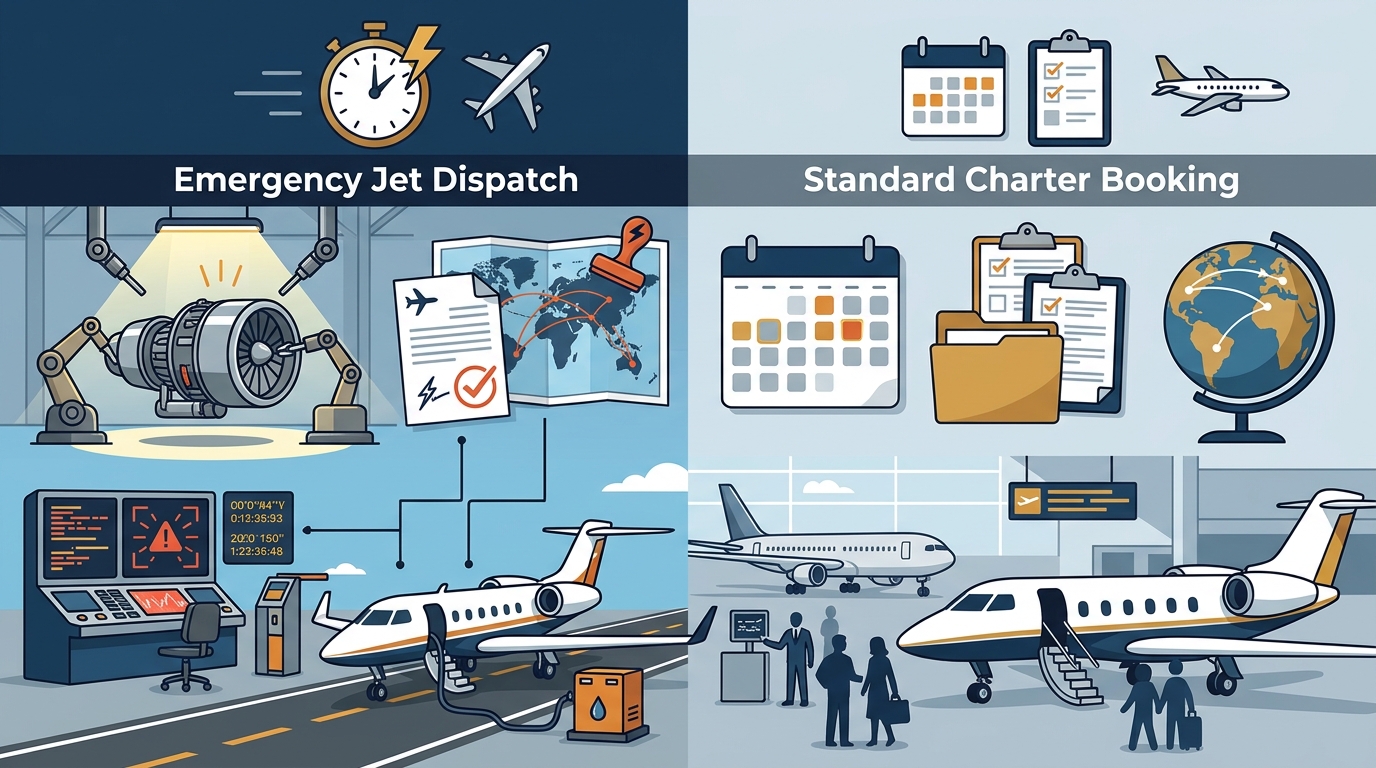
Emergency jet dispatch is a rapid-response operational workflow designed to secure aircraft, crew, and regulatory approvals within hours rather than days. Unlike standard charter booking, which relies on scheduled availability and pre-planned logistics, emergency dispatch prioritizes immediate asset mobilization and real-time coordination. This distinction is critical for travelers facing time-sensitive legal, medical, or corporate obligations where standard lead times are insufficient.
The Speed of Asset Mobilization
Standard charter booking typically requires 24 to 72 hours of lead time to secure an aircraft. This window allows brokers to compare multiple operators, verify maintenance status, and finalize catering or ground transport. Emergency dispatch compresses this timeline to as little as four hours. The primary difference lies in the pre-qualification of the operator network. In an emergency, the broker cannot afford to vet a new operator from scratch. Instead, they rely on a pre-vetted pool of ARGUS and Wyvern-rated carriers that are already on standby or in a state of high readiness.
This pre-qualification is the core of the emergency dispatch system. It shifts the burden of safety compliance from the point of booking to the point of network entry. For a traveler, this means the safety audit is already complete. The broker’s role shifts from a general sales agent to a tactical coordinator who can immediately identify which aircraft in the network is closest to the departure point and has the required crew availability. This operational shift is what allows for the rapid turnaround that defines emergency aviation.
Navigating Regulatory and Airspace Constraints
Standard bookings often assume standard airspace routing and predictable slot allocations. Emergency dispatch, however, frequently involves navigating complex airspace restrictions, particularly in high-density regions like New York or London. The dispatch system must account for real-time airspace closures, weather deviations, and slot availability at the destination. In many cases, an emergency flight requires a direct coordination with air traffic control to secure a priority slot or a specific routing that a standard scheduled flight would not receive.
The implication for the traveler is that the broker must possess deep regional expertise. A generic booking system might suggest a route that is technically possible but operationally risky due to weather or congestion. An emergency dispatch system, by contrast, uses real-time data to select the safest and fastest path. This level of granularity is essential when the margin for error is measured in minutes. The system must not only find a plane but also ensure that the plane can legally and safely reach its destination in the required timeframe.
Crew Availability and Maintenance Verification
In a standard charter, crew availability is a secondary consideration after the aircraft is selected. In emergency dispatch, crew readiness is the primary constraint. Pilots are subject to strict flight time limitations, and an emergency request may require a crew that is currently off-duty but within a specific geographic radius. The dispatch system must instantly verify that the assigned crew is within legal duty limits and physically located near the aircraft. This requires a level of real-time data integration that standard booking platforms often lack.
Maintenance status is another critical differentiator. Standard bookings may allow for a minor maintenance check to be performed during the booking window. Emergency dispatch requires the aircraft to be in a state of immediate airworthiness. The broker must confirm that no outstanding maintenance items exist that could delay the departure. This verification process is automated in advanced dispatch systems, allowing the broker to rule out unsuitable aircraft in seconds. The result is a higher confidence in the final booking, as the operational risks are mitigated before the client is even presented with the option.
Communication and Client Coordination
Standard charter communication follows a predictable cadence: inquiry, quote, confirmation, and pre-flight briefing. Emergency dispatch communication is continuous and high-intensity. The client, the broker, the operator, and the ground handlers must be in constant contact. Any change in the client’s schedule or the aircraft’s status requires immediate re-evaluation. This requires a dedicated point of contact who is available 24/7 and has the authority to make rapid decisions on behalf of the client.
The implication is that the service model must be human-centric, even if the underlying system is automated. A chatbot or automated email system is insufficient for an emergency. The client needs a senior advisor who can explain the options, manage expectations, and coordinate with the operator in real time. This high-touch approach is what distinguishes a luxury emergency dispatch service from a basic last-minute booking tool. It ensures that the client is not left in the dark during a high-stress situation.
Cost Structures and Pricing Dynamics
Standard charter pricing is often based on a fixed hourly rate that includes a buffer for standard operational costs. Emergency dispatch pricing is dynamic and reflects the premium for immediate availability. The cost is not just for the flight; it is for the mobilization of the entire operational chain. This includes the crew, the ground handlers, and the regulatory coordination. As a result, emergency charters are typically more expensive per hour than standard bookings. However, the cost is justified by the certainty of execution and the speed of delivery.
For clients, understanding this cost structure is important. It is not a markup for the sake of profit; it is a reflection of the operational resources required to meet the deadline. A standard booking might allow for a more cost-effective aircraft, while an emergency booking requires the most available and suitable aircraft, regardless of its base rate. This difference in pricing philosophy is a key factor in deciding whether to use an emergency dispatch service or a standard charter broker.
Key Takeaways
- Emergency dispatch relies on a pre-vetted network of operators to bypass standard safety audits.
- Lead times for emergency dispatch are typically under four hours, compared to 24-72 hours for standard charters.
- Crew availability and maintenance status are primary constraints in emergency dispatch, not secondary considerations.
- Real-time airspace and slot coordination is essential for emergency flights in high-density regions.
- Communication in emergency dispatch is continuous and requires a dedicated 24/7 human advisor.
- Emergency charter pricing reflects the premium for immediate mobilization and operational certainty.
Frequently Asked Questions
How fast can an emergency jet be dispatched?
With a pre-vetted network, an emergency jet can often be dispatched in as little as four hours, depending on aircraft and crew availability.
Is emergency dispatch more expensive than standard charter?
Yes, emergency dispatch typically carries a premium due to the immediate mobilization of crew, ground handlers, and regulatory coordination.
Do emergency flights use the same safety standards as standard charters?
Yes, emergency dispatch relies on pre-vetted operators that meet the same ARGUS and Wyvern safety standards as standard charters.
Can emergency dispatch handle international flights?
Yes, but it requires additional coordination for customs, permits, and international airspace slots, which can extend the timeline.
What is the role of the broker in emergency dispatch?
The broker acts as a tactical coordinator, verifying real-time availability, crew status, and regulatory compliance in seconds.
Conclusion
Emergency jet dispatch is a specialized operational discipline that prioritizes speed, real-time coordination, and pre-qualified safety. It differs from standard charter booking in its reliance on immediate asset mobilization and continuous human oversight. For travelers with time-sensitive needs, understanding these differences is essential for selecting the right service. Request a charter quote with Zephyr Jets to experience the precision of our emergency dispatch system. Learn more: Contact Us Zephyr Jets.