

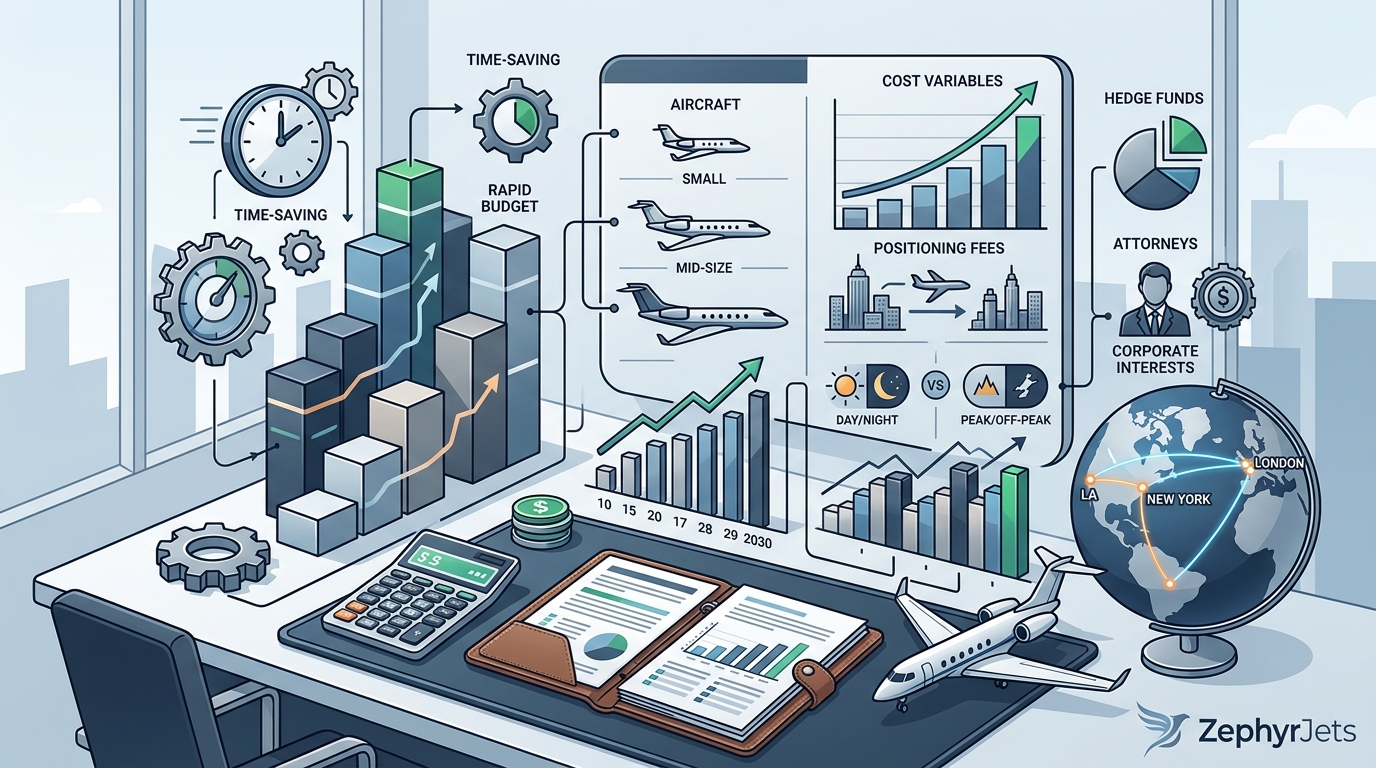
Corporate travel budgets are shifting rapidly as executives prioritize time efficiency over traditional commercial constraints. According to recent industry analyses, the global private aviation market is projected to grow at a compound annual growth rate exceeding 6% through 2030, driven largely by corporate demand for flexible, on-demand travel solutions. Understanding the true cost of chartering a private jet is no longer just about the hourly rate; it involves navigating complex variables like aircraft category, positioning fees, and operational timing. This guide breaks down the financial realities of business jet charters in 2026, helping you allocate resources effectively while maintaining the highest standards of executive comfort and security.
Understanding Charter Pricing Models
Before committing to a specific aircraft, it is essential to understand how private jet charter costs are calculated. Unlike commercial airlines that offer fixed ticket prices, private aviation operates on a dynamic pricing model. The primary driver of cost is the aircraft's hourly rate, which varies significantly based on the jet's size, age, and performance capabilities. However, the final invoice is rarely just a simple multiplication of hours flown.
Charter brokers and operators typically structure quotes around several core components. These include the base hourly flight rate, landing fees at both origin and destination airports, fuel surcharges, and crew expenses. For international flights, additional costs such as overflight permits, customs handling, and de-icing fees (in winter months) are added to the final tally. Transparency in these line items is critical for accurate budgeting.
At Zephyr Jets, we prioritize transparent pricing by providing itemized quotes that eliminate hidden fuel surcharges and unexpected fees. Our advisors ensure that every dollar is accounted for, allowing corporate travel managers to predict costs with precision. This approach aligns with the industry's shift toward private aviation transparency, where clients demand clear visibility into operational costs.
Aircraft Category Cost Breakdown
Selecting the right aircraft is the most significant factor in determining your charter cost. Each category offers distinct advantages in terms of range, cabin comfort, and speed. Below is a detailed analysis of the primary aircraft categories available for business charters.
Light Jets
Light jets are the most cost-effective option for short-haul business trips. These aircraft typically seat 4 to 7 passengers and have a range of 1,500 to 2,000 nautical miles. They are ideal for regional travel, such as flying from New York to Washington D.C. or Los Angeles to San Diego. The lower operating costs of light jets make them the preferred choice for frequent, shorter corporate hops.
Midsize Jets
Midsize jets offer a balance of range and comfort, seating 6 to 8 passengers with a range of 2,000 to 3,000 nautical miles. These aircraft can fly coast-to-coast in the United States without refueling. They often feature a standing cabin and a dedicated lavatory, providing a more spacious environment for working or relaxing during the flight. The midsize category includes popular models like the Hawker and Citation XLS.
Super Midsize Jets
Super midsize jets bridge the gap between midsize and heavy jets. They offer enhanced range, often exceeding 3,000 nautical miles, and larger cabins that allow for greater comfort on longer transcontinental flights. Aircraft like the Challenger 350 and G280 are staples in this category, offering high-speed cruise capabilities that reduce travel time significantly.
Heavy and Ultra-Long Range Jets
For international business trips, heavy and ultra-long range jets are the standard. These aircraft can seat 10 to 16+ passengers and have ranges exceeding 6,000 nautical miles. Models like the Gulfstream G650 and Bombardier Global 7500 offer full flat-bed sleeping configurations, conference areas, and private showers. While the hourly rate is substantially higher, the ability to fly non-stop across continents justifies the cost for global executives.
Hidden Fees and Operational Surcharges
Many first-time charterers are surprised by the additional costs that appear on the final invoice. Understanding these surcharges is vital for accurate budgeting. One of the most significant hidden costs is the positioning fee, also known as the deadhead fee. If an aircraft must fly from its home base to your departure airport to pick you up, you are typically charged for that empty leg.
Other common surcharges include:
- Landing and Handling Fees: These vary by airport and can range from a few hundred to several thousand dollars, especially at premium airports like Teterboro or London City.
- Overnight Crew Fees: If the flight duration requires the crew to stay overnight, the charterer is responsible for their hotel and per diem expenses.
- De-icing and Weather Delays: In winter months, de-icing fluids are expensive, and delays caused by weather may incur hourly standby fees.
- International Permits: Flying across borders requires complex paperwork and permits, which add to the operational cost.
At Zephyr Jets, we mitigate these surprises by providing detailed, itemized quotes that clearly outline every potential cost. Our 16 years of experience allow us to anticipate these variables and advise clients on how to minimize them, ensuring that the final price matches the initial estimate.
The Empty Leg Strategy for Cost Savings
One of the most effective ways to reduce private jet charter costs is to book an empty leg flight. An empty leg occurs when a jet needs to reposition itself after dropping off passengers or returning to its home base. Instead of flying empty, the operator offers the flight at a discounted rate, often up to 75% off the retail price.
While empty legs offer significant savings, they come with trade-offs. The schedule is fixed, and flexibility is limited. If your business trip plans change, you may lose the deposit. However, for adaptable executives, empty legs provide access to heavy and ultra-long range jets at prices comparable to light jets.
Zephyr Jets maintains a daily list of empty leg flights, allowing clients to monitor opportunities in real-time. Our advisors specialize in matching these available legs with client itineraries, ensuring that you never miss a cost-saving opportunity without compromising on safety or reliability.
Route-Specific Pricing Examples
To provide a clearer picture of charter costs, here are estimated price ranges for some of the most requested business routes. These figures are based on current market rates for 2026 and assume a midsize jet for standard transcontinental travel.
| Route | Aircraft Category | Estimated Cost | Flight Time |
|---|---|---|---|
| New York (TEB) to London (LHR) | Ultra Long Range | From $110,000 | 7 Hours |
| Teterboro to Aspen (ASE) | Super Midsize | From $42,000 | 4 Hours 30 Minutes |
| Los Angeles (VNY) to Las Vegas (LAS) | Light Jet | From $9,500 | 1 Hour 5 Minutes |
| Miami (MIA) to Nassau (NAS) | Light Jet | From $6,800 | 50 Minutes |
| Van Nuys to Cabo San Lucas (SJD) | Midsize | From $26,000 | 2 Hours 40 Minutes |
These estimates highlight the dramatic cost difference between regional and international travel. For example, a short hop to Las Vegas is accessible to many mid-sized corporations, while transatlantic travel requires a significant budget allocation. Understanding these benchmarks helps corporate travel managers set realistic expectations and allocate funds appropriately.
Key Takeaways
- Cost Variables: Charter costs are driven by aircraft category, flight hours, and operational surcharges like positioning fees.
- Transparency: Reputable brokers like Zephyr Jets provide itemized quotes to prevent hidden fees.
- Empty Legs: Booking empty leg flights can save up to 75% on ultra-long range travel.
- Aircraft Selection: Light jets are cost-effective for regional travel, while heavy jets are necessary for international missions.
- Market Growth: The private aviation sector is expanding, with corporate demand driving innovation in pricing models.
- Experience Matters: Brokers with 15+ years of experience, such as those at Zephyr Jets, can navigate complex logistical challenges more effectively.
- 2026 Pricing: Fuel volatility and airport demand continue to influence hourly rates, making early booking advisable.
Frequently Asked Questions
How is the cost of a private jet charter calculated?
Charter costs are primarily calculated based on the aircraft's hourly flight rate multiplied by the total flight time. Additional costs include landing fees, fuel surcharges, crew expenses, and positioning fees if the aircraft must travel to your departure airport.
What is the cheapest type of private jet to charter?
Light jets are generally the most affordable option for chartering. They have lower operating costs and are ideal for short-distance business trips, typically seating 4 to 7 passengers with a range of up to 2,000 nautical miles.
Can I save money by booking an empty leg flight?
Yes, empty leg flights can offer discounts of up to 75% off the standard retail price. However, these flights have fixed schedules and limited flexibility, making them best suited for adaptable travelers.
How far in advance should I book a private jet for business?
While Zephyr Jets can arrange flights in as little as 4 hours, booking 2 to 3 weeks in advance typically yields better pricing and ensures the availability of your preferred aircraft type.
Are there hidden fees in private jet charters?
Reputable brokers provide transparent, itemized quotes. However, clients should be aware of potential surcharges like de-icing, overnight crew fees, and international permits, which are standard industry practices.
What is the average cost of a transatlantic private jet flight?
A transatlantic flight from New York to London in an ultra-long range jet typically costs between $100,000 and $150,000, depending on the specific aircraft model and current fuel prices.
Does Zephyr Jets own the aircraft it charts?
No, Zephyr Jets is an elite charter broker. We do not own or operate aircraft but partner with a network of ARGUS and Wyvern-rated operators to ensure the highest safety and service standards.
Book Your Next Executive Flight
Navigating the complexities of private jet charter costs requires expertise, transparency, and a vast network of verified operators. At Zephyr Jets, we combine 16 years of industry experience with a commitment to clear, honest pricing to deliver exceptional value for your business travel needs. Whether you require a light jet for a regional meeting or a heavy jet for a global summit, our team is ready to assist.
Visit our Advanced Jet Quotes page to receive a detailed, itemized estimate for your next trip. For immediate assistance, contact our 24/7 operations team at +1-212-561-5500. Experience the Zephyr Jets difference, where elite service meets financial clarity.