

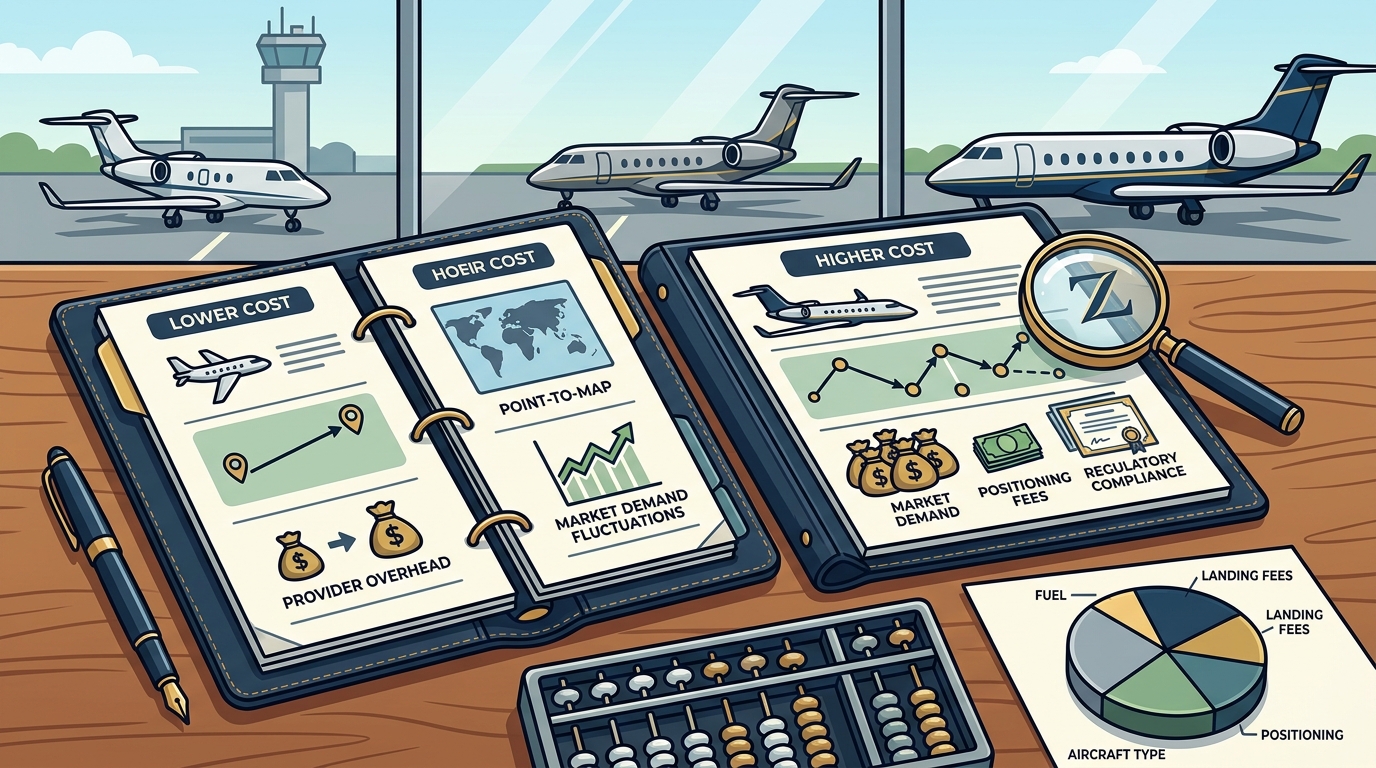
Industry data shows that private aviation pricing varies by nearly 40 percent depending on aircraft class, routing complexity, and provider overhead. Charter flight rates fluctuate based on real-time market demand, positioning fees, and regulatory compliance costs. Understanding these variables helps executives allocate capital efficiently while maintaining operational flexibility. This analysis breaks down the financial mechanics behind different booking models, revealing how strategic scheduling and aircraft selection directly impact your bottom line. (Business aviation market)
Core Pricing Variables
Base Hourly Rates
Providers establish base hourly rates by calculating fuel consumption, maintenance reserves, and crew salaries. Executive jet pricing typically ranges from $4,500 to $15,000 per flight hour depending on the airframe. These baseline figures cover the core operation but rarely reflect the final invoice total. Operators must factor in variable expenses that accumulate during transit.
Positioning and Deadhead Costs
Aircraft positioning is the process of relocating an empty plane to a passenger pickup location. Deadhead costs represent the financial expense of flying an aircraft without revenue-generating passengers. When a provider lacks an aircraft at your departure airport, they charge a positioning fee to cover the repositioning flight. This fee often equals 50 to 75 percent of the standard hourly rate. Strategic providers maintain regional fleets to minimize these repositioning charges.
Aircraft Class Impact
Light Jet Economics
Light jets offer the most accessible entry point into private aviation. These aircraft typically seat four to six passengers and cruise at 450 miles per hour. Light jet charter costs generally fall between $4,500 and $7,500 per hour. They excel at reaching shorter runways and regional airports that larger aircraft cannot access. This accessibility reduces ground transportation expenses for corporate teams. (Private Jet Charter)
Heavy Jet Premiums
Heavy jets command premium rates due to their long-range capabilities and cabin comfort. These aircraft accommodate eight to sixteen passengers while maintaining a pressurized cabin at 6,000 feet. Heavy jet operational costs typically range from $8,000 to $15,000 per hour. The extended range allows nonstop transcontinental travel without fuel stops. Executives prioritize heavy jets when time efficiency and cabin workspace outweigh initial budget constraints.
Empty Leg Strategy
Discounted Routing Options
Empty leg pricing refers to discounted rates for one-way flights returning to a home base. Empty leg savings frequently drop by 50 to 75 percent compared to standard charter rates. These opportunities arise when operators must reposition aircraft after dropping off passengers. Travelers with flexible schedules can secure premium aircraft at midsize jet prices. This model requires rapid booking decisions and rigid itinerary adherence. (Research Guides Statistical)
Service Tier Comparison
On-Demand Charter Models
On-demand charter services provide maximum flexibility without long-term financial commitments. On-demand charter models charge market rates that adjust to seasonal demand and aircraft availability. This structure suits businesses with unpredictable travel patterns or occasional high-priority missions. Clients pay only for the exact flight duration and routing requirements. The tradeoff involves higher per-hour costs compared to committed usage programs.
Hidden Fees and Add-Ons
Landing and Handling Charges
Providers pass regulatory and infrastructure costs directly to the passenger. Landing and handling charges vary significantly based on airport classification and regional taxes. Major hubs impose higher fees than regional airfields. These costs typically range from $200 to $2,500 per landing. Transparent brokers disclose these variables before finalizing the reservation.
Crew and Catering Expenses
Professional cabin crews require specific compensation structures and rest protocols. Catering and crew expenses add a fixed premium to every itinerary. Premium meal packages, specialty beverages, and ground transportation arrangements increase the final invoice. Savvy travelers pre-approve these add-ons to avoid surprise charges during the booking process.
Key Takeaways
- Private aviation pricing fluctuates by 40 percent based on aircraft class and routing complexity.
- Light jet hourly rates typically range from $4,500 to $7,500 for short regional trips.
- Heavy jet operational costs average $8,000 to $15,000 per hour for transcontinental missions.
- Empty leg discounts frequently reduce premium aircraft rates by 50 to 75 percent.
- Positioning fees account for 50 to 75 percent of standard hourly rates when repositioning is required.
- Landing and handling charges vary from $200 to $2,500 depending on airport classification.
- Transparent brokers disclose all variable expenses before finalizing the reservation contract.
| Aircraft Category | Hourly Rate Range | Passenger Capacity | Best Use Case | Provider Link |
|---|---|---|---|---|
| Very Light Jets | $3,500 - $4,500 | 3 to 4 | Short regional hops | View Fleet |
| Light Jets | $4,500 - $7,500 | 4 to 6 | Executive team travel | Request Quote |
| Midsize Jets | $6,500 - $9,000 (GDP per capita) | 6 to 8 | Transcontinental missions | Explore Options |
| Heavy Jets | $8,000 - $15,000 | 8 to 16 | Long-haul comfort | Browse Gallery |
Frequently Asked Questions
How do hourly rates differ between light and heavy jets?
Light jets operate between $4,500 and $7,500 per hour, while heavy jets range from $8,000 to $15,000 per hour. The price difference reflects fuel consumption, maintenance reserves, and cabin space allocation. Heavy jets justify their premium through extended range and pressurized comfort.
What exactly is an empty leg flight?
An empty leg flight occurs when an aircraft returns to its home base without passengers. Empty leg pricing allows travelers to book these repositioning flights at heavily discounted rates. Flexibility is the primary requirement for securing these opportunities.
Are positioning fees included in the base hourly rate?
Positioning fees rarely appear in the base hourly rate. Positioning charges apply when the operator must fly an empty aircraft to your departure airport. These fees typically cover 50 to 75 percent of the standard hourly rate.
How do landing charges impact the total charter cost?
Landing charges vary by airport classification and regional tax structures. Handling fees typically range from $200 to $2,500 per landing. Major international hubs impose higher infrastructure costs than regional airfields.
What distinguishes on-demand charters from jet card programs?
On-demand charters charge market rates without long-term commitments. Service tier models adjust pricing based on seasonal demand and aircraft availability. Jet cards require upfront capital but guarantee fixed hourly rates and priority scheduling.
Do catering and crew expenses affect the final invoice?
Catering and crew expenses add a fixed premium to every itinerary. Catering packages typically range from $150 to $500 per passenger. Premium meal selections and specialty beverages increase the final invoice total.
How quickly can providers schedule a last-minute charter?
Experienced operators can schedule flights within 4 hours of request. Rapid deployment requires pre-vetted aircraft and available crew members. Urgent missions often incur premium pricing due to limited availability.
Book Your Flight
Understanding the cost difference between private jet providers empowers executives to allocate capital efficiently. Request a detailed quote today to compare real-time pricing across our global fleet. Our dedicated advisors analyze your routing requirements and match you with the most cost-effective airframe. Secure your preferred aircraft and experience seamless executive travel.