

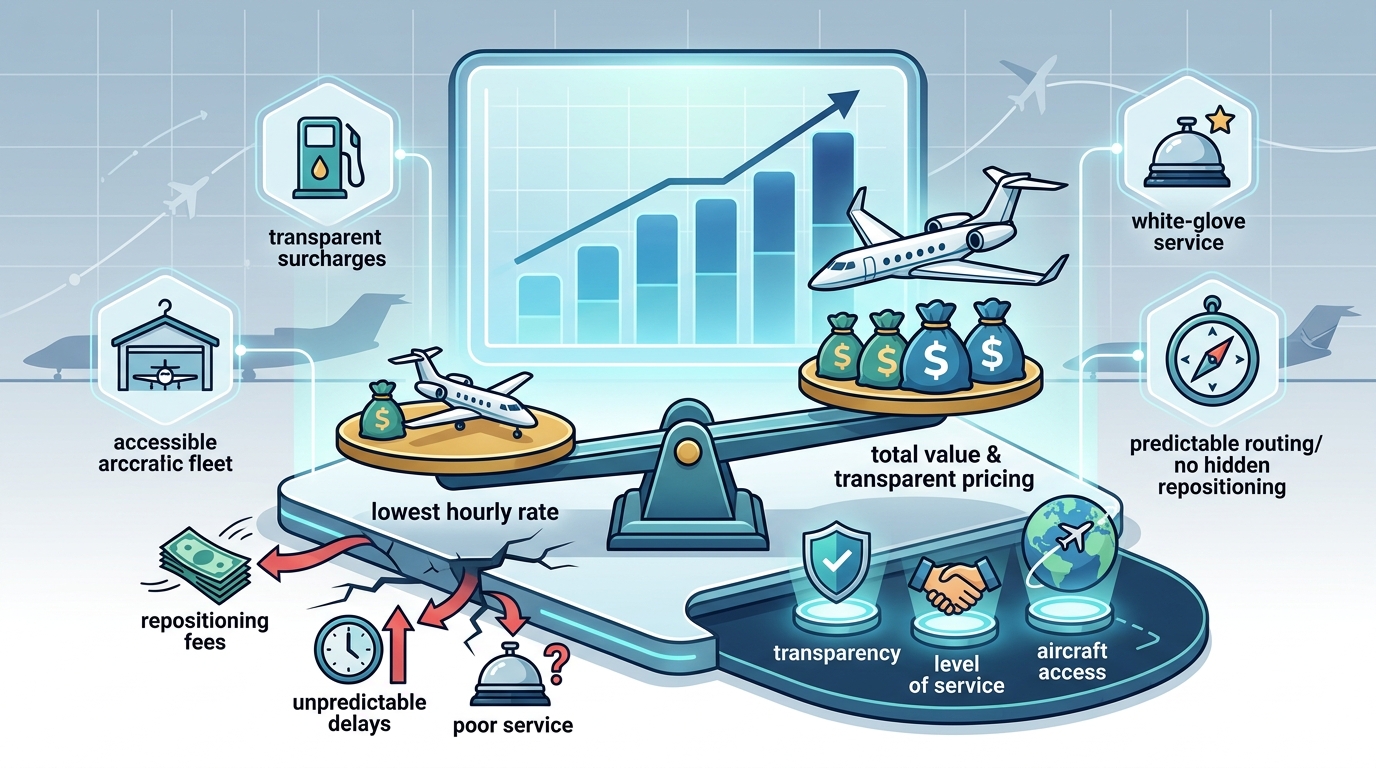
Choosing a private jet provider is not just about finding the lowest hourly rate. The real cost difference between private jet companies comes down to pricing transparency, aircraft access, repositioning fees, and the level of service you receive before, during, and after each flight. In 2026, hourly charter rates range from $2,000 for turboprops to more than $14,000 for ultra-long-range jets, but the final invoice depends on factors most travelers never see until it is too late. This guide breaks down exactly what drives those differences so you can make a confident, informed decision.
Hourly Rates by Aircraft Category
A private jet charter is the hiring of an entire aircraft and crew for a specific trip under FAA FAR Part 135 regulations. Hourly rates are the starting point for any quote, but they vary widely by aircraft size, age, and model.
| Aircraft Category | Passengers | Hourly Rate (2026) | Typical Range |
|---|---|---|---|
| Turboprop | 6 - 8 | $2,000 - $3,000 | Up to 1,000 nm |
| Light Jet | 6 - 8 | $2,600 - $3,500 | 1,500 - 2,000 nm |
| Midsize Jet | 8 - 10 | $3,500 - $6,000 | 2,000 - 3,000 nm |
| Super Midsize | 8 - 12 | $5,000 - $8,000 | 3,000 - 3,500 nm |
| Heavy / Long-Range | 10 - 16 | $7,000 - $14,000 | 4,500+ nm |
| Ultra-Long-Range | 12 - 19 | $10,000 - $14,000+ | 6,000+ nm |
Model-specific premiums matter too. A newer Gulfstream G650 commands $200 to $2,000 more per hour than an older Falcon 900 in the same heavy-jet category. When comparing providers, always confirm the specific aircraft model included in your quote.
Hidden Costs That Separate Providers
The biggest price gaps between charter companies are not in their hourly rates. They are in the line items that appear after you have already committed. Understanding these extras is critical.
Repositioning (Ferry) Fees
A repositioning fee is the cost of flying an empty aircraft to your departure airport. If your provider does not have access to a large fleet network, these deadhead legs can add thousands to your invoice. Providers with access to 3,500+ aircraft, like ZephyrJets' on-demand charter service, can often position a closer aircraft and reduce or eliminate this charge.
Peak-Season Surcharges
During high-demand periods like Thanksgiving, New Year's, and major sporting events, charter rates typically surge 20 to 40 percent above baseline. Some providers lock in peak pricing weeks in advance, while others apply surcharges at booking.
Taxes and Segment Fees
The IRS applies a 7.5% Federal Excise Tax to all domestic charter flights, plus a per-segment fee of approximately $4.80 per takeoff-landing leg. These charges are non-negotiable regardless of the provider you choose.
Pricing Models: On-Demand vs. Jet Cards vs. Memberships
A jet card is a prepaid account that locks in a fixed hourly rate for a set number of flight hours. Jet cards can offer cost predictability, but they require a significant upfront deposit, typically $100,000 or more. ZephyrJets offers the Sky Card jet card program for clients who fly frequently.
On-demand charter is the most flexible model. You pay per trip with no long-term commitment. This works best for travelers who fly fewer than 50 hours per year or need access to different aircraft types. Fractional ownership, by contrast, involves purchasing a share of an aircraft with annual fixed costs exceeding $1 million, making it practical only for those flying 200+ hours annually.
2026 Market Trends Affecting Charter Prices
The charter market has shifted meaningfully since the post-pandemic surge. According to data cited by Forbes, private jet charter rates grew by just 1.7% year-over-year in 2025, compared to 2.7% for overall U.S. CPI. That decoupling signals a pricing stabilization after years when charter inflation ran two to three times faster than consumer prices.
However, 2026 brings new pricing pressure. Jet fuel prices have risen roughly 30% since March 2026, pushing overall charter costs up 15 to 20% on some routes. The FIFA World Cup, hosted across 16 U.S. cities this summer, is projected to generate over 73,000 related private jet flights, further tightening availability in New York, Los Angeles, Miami, and Dallas.
How to Compare Quotes the Right Way
Not all quotes are created equal. When you receive pricing from multiple providers, use this checklist to make an apples-to-apples comparison:
- Confirm billable time: Is pricing wheels-up to wheels-down, or does it include taxi time?
- Ask about repositioning: Is the ferry leg included or itemized separately?
- Check for fuel surcharges: Are fuel costs locked in or subject to adjustment?
- Review overnight fees: Crew overnight costs typically run $1,500 to $3,500 per night.
- Verify airport options: Choosing a secondary airport like Burbank over LAX or Teterboro over JFK can save $1,000 to $3,000 per trip.
Requesting an itemized quote from ZephyrJets ensures you see every cost before signing a reservation form.
Why ZephyrJets Delivers Better Value
ZephyrJets has spent over 16 years building relationships with operators worldwide, giving clients access to more than 3,500 aircraft. This fleet depth translates directly into cost savings because a closer aircraft means lower repositioning fees and faster departure times.
ZephyrJets also offers point-to-point pricing with fares that are consistently 40 to 60 percent lower than standard round-trip charter rates. For one-way travelers, this pricing structure eliminates the common industry practice of billing for a round trip even when you only fly one direction.
On popular routes like New York to London, empty leg pricing typically ranges from $60,000 to $80,000, with the possibility of further savings depending on schedule flexibility. Every quote comes with no hidden fees and clear contracts, backed by 24/7 support from dedicated charter specialists.
Key Takeaways
- Hourly charter rates in 2026 range from $2,000 for turboprops to $14,000+ for ultra-long-range jets.
- The real cost difference between providers lies in repositioning fees, fuel surcharges, and peak-season pricing.
- Charter rate inflation has slowed to 1.7%, but fuel spikes and the 2026 World Cup are pushing summer prices higher.
- Always compare quotes on an all-inclusive basis, including ferry legs, overnight fees, and taxes.
- Empty leg flights can save 40 to 60% off standard one-way fares on popular routes.
- Providers with large fleet networks reduce repositioning costs and offer faster aircraft availability.
- ZephyrJets' point-to-point pricing model eliminates hidden round-trip markups for one-way travelers.
Frequently Asked Questions
How much does it cost to charter a private jet in 2026?
In 2026, private jet charter costs range from approximately $2,000 per hour for a turboprop to over $14,000 per hour for an ultra-long-range jet. A coast-to-coast flight from New York to Los Angeles on a super midsize jet typically costs $35,000 to $45,000 one way.
Why do quotes vary so much between providers?
Quote variations stem from differences in fleet access, repositioning distances, fuel pricing policies, and broker markups. Some providers include all fees upfront while others add charges after booking. Always request an itemized breakdown before committing.
What is an empty leg flight?
An empty leg flight is a repositioning flight that occurs when an aircraft needs to return to its base or fly to its next booking location without passengers. Booking an empty leg can save 40 to 60% compared to a standard charter fare.
Are jet cards worth it?
Jet cards offer fixed hourly rates and guaranteed availability, making them worthwhile for travelers who fly 25 to 50+ hours per year. For occasional flyers, on-demand charter typically offers better overall value without a large upfront deposit.
What hidden fees should I watch for?
Common hidden fees include aircraft repositioning charges, crew overnight expenses, de-icing costs in winter ($1,500 to $12,000), peak-day surcharges of 10 to 30%, and international handling fees for permits and customs clearance.
How does the 2026 World Cup affect charter pricing?
The FIFA World Cup is expected to generate over 73,000 related private jet flights across 16 U.S. host cities. Aircraft availability will tighten significantly in New York, Los Angeles, Miami, and Dallas during match days, pushing rates higher during peak summer weeks.
Can I save money by choosing a different airport?
Yes. Using secondary airports like Teterboro instead of JFK in New York, or Burbank instead of LAX in Los Angeles, can reduce landing fees and FBO charges by $1,000 to $3,000 per trip. ZephyrJets' specialists can recommend the most cost-effective airports for your route.
How far in advance should I book a charter flight?
For standard travel, booking 48 to 72 hours in advance is usually sufficient. During peak seasons or major events, a 7 to 14-day lead time is recommended to secure preferred aircraft and competitive pricing.
Get Your Personalized Charter Quote
Ready to see how ZephyrJets compares? Request a free, itemized quote or call our team anytime at (212) 561-5500. Our specialists are available 24/7 to match you with the right aircraft at the best available price.