
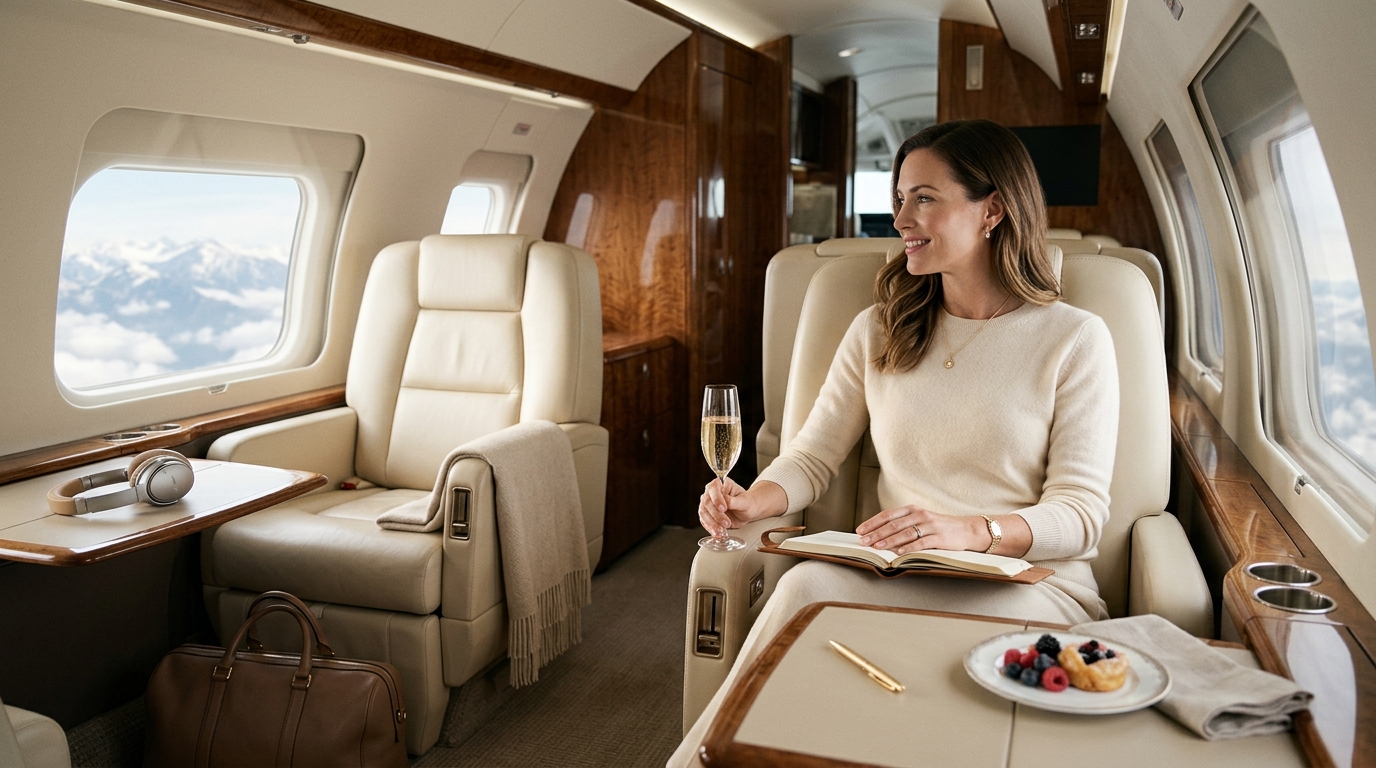
Private aviation in 2026 isn't a vanity purchase—it's a lifestyle infrastructure decision. With flight activity now 32% above pre-pandemic levels and the charter market valued at $17.67 billion, the case for flying private has never been more data-driven. Here, Zephyr Jets outlines eight distinct advantages that separate private jet travel from even the best first-class cabin.
1. Point-to-Point Routing to 5,000+ Airports
Commercial airlines funnel passengers through a handful of congested hubs. Private aviation flips that model entirely. According to the National Business Aviation Association (NBAA), private aircraft can access ten times more airports in the United States than commercial carriers. That means landing 20 minutes from your coastal villa in Nantucket, your vineyard estate in Napa, or a resort town in the Dolomites—places no major airline serves directly.
For luxury travelers, this translates to fewer ground transfers, shorter total door-to-door journeys, and the ability to build multi-stop itineraries across remote or underserved destinations without backtracking through a hub city.
2. The 15-Minute Boarding Window
One of the most tangible advantages is the elimination of the airport gauntlet. Private jet passengers typically arrive just 15–20 minutes before departure, drive directly to the aircraft on a private ramp, and board without security queues, gate changes, or boarding groups. On a round-trip itinerary, that can recover three to four hours of productive time compared with commercial first class—time that compounds across dozens of annual trips.
3. Airborne Productivity That Pays for Itself
A private cabin is a fully secure mobile office. Executives hold confidential board calls, review deal documents, or rehearse investor presentations without worrying about seatmates overhearing proprietary information. High-speed satellite Wi-Fi, power at every seat, and configurable meeting layouts are now standard on midsize and larger jets.
In 2026, 81% of affluent travelers aged 18–35 work remotely, making the ability to remain connected and productive at 41,000 feet a non-negotiable requirement rather than a perk. For C-suite leaders managing multi-continent schedules, private jets convert dead transit time into billable, decision-making hours.
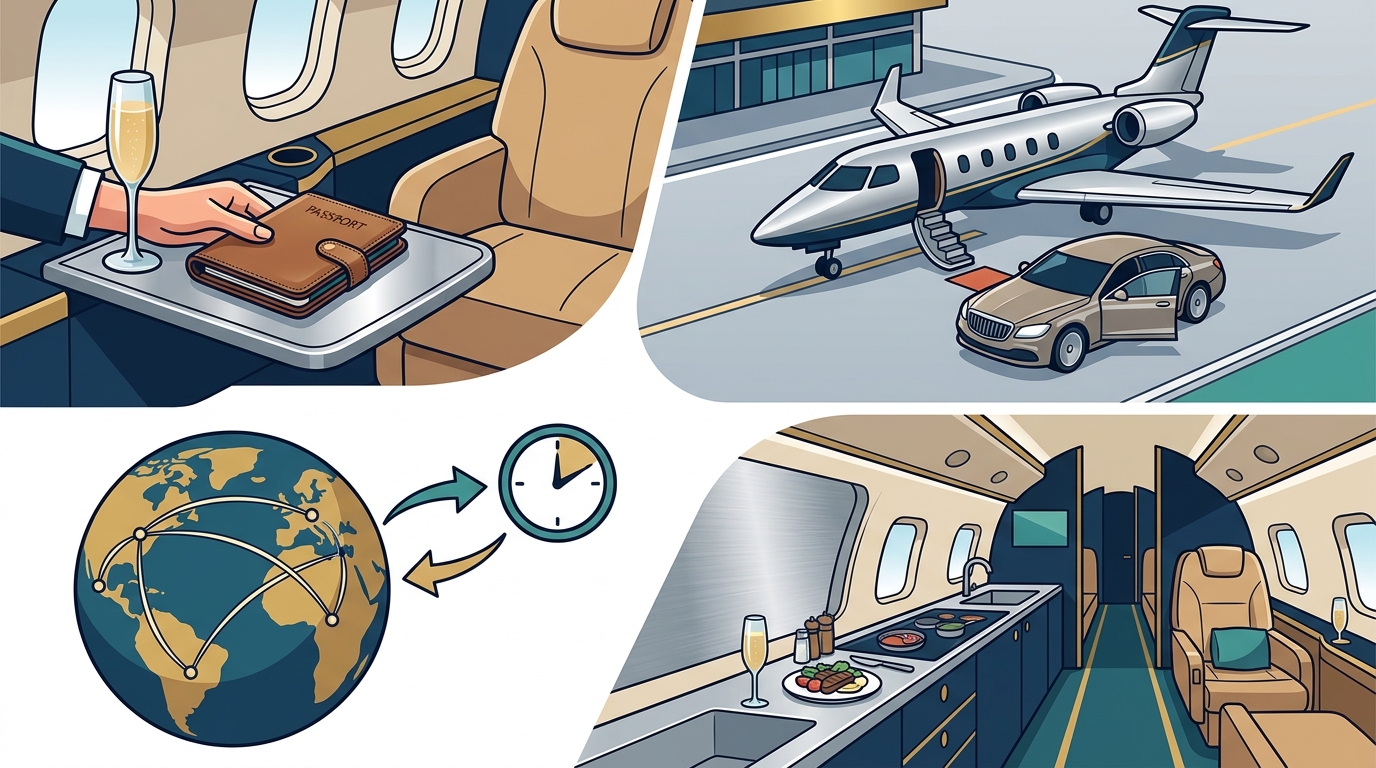
4. Full-Spectrum Trip Customization
Luxury is personal, and private aviation leans into that principle harder than any other travel category. Today's operators store individual traveler preferences—preferred cabin temperature, dietary requirements, entertainment libraries, even pillow firmness—and replicate them on every future flight.
Catering can be sourced from a passenger's favorite restaurant in the departure city. Cabin configurations shift from boardroom to bedroom at the push of a button on newer large-cabin platforms like the Bombardier Global 7500 or Gulfstream G700. The result is a journey that feels less like transportation and more like an extension of your personal living space.
5. Healthier Cabins, Less Jet Lag
Modern private jets maintain lower cabin altitudes—often the equivalent of 4,000–6,000 feet compared with 6,000–8,000 feet on commercial widebodies. The practical impact is significant: higher blood-oxygen levels, reduced fatigue, and noticeably less jet lag after long-haul flights. Manufacturers such as Bombardier have introduced dedicated cabin wellness systems that improve air circulation and reduce physical stress during intercontinental travel.
Advanced air filtration—including HEPA and photocatalytic oxidation systems—cycles cabin air more frequently than commercial aircraft, offering a cleaner breathing environment that health-conscious luxury travelers increasingly demand.
6. Group Economics That Surprise
Private jet pricing is per-aircraft, not per-seat. A midsize jet seating eight passengers on a two-hour domestic hop can bring the per-person cost closer to a premium commercial ticket once you factor in baggage fees, lounge access, ground transport savings, and—most importantly—the value of time recovered. For families, executive teams, or friend groups traveling together, the economics shift further in private aviation's favor.
Add empty-leg positioning flights, which can discount one-way fares by 25–50%, and the financial calculus becomes surprisingly accessible for semi-regular travelers.
7. Flexible Access Models for Every Travel Profile
You no longer need to buy an aircraft to fly privately. The industry now offers a spectrum of entry points: on-demand charter for occasional trips, jet card programs that lock in fixed hourly rates, fractional ownership for frequent flyers, and membership subscriptions that guarantee availability with monthly fees. Fractional fleets alone have grown more than 65% since 2019, reaching approximately 1,300 aircraft in service.
This diversification has opened the door to a broader traveler demographic. First-time private flyers increased by 21% between 2022 and 2024, signaling that the barriers to entry are falling fast. Zephyr Jets works across all of these models to match each client with the structure that fits their annual travel rhythm and budget.
8. A Clearer Path to Sustainable Travel
Environmental responsibility is now a buying criterion, not an afterthought. More operators are investing in Sustainable Aviation Fuel (SAF), newer-generation engines that burn less fuel, and carbon-offset reporting after each journey. Several 2026-generation aircraft boast meaningfully lower per-nautical-mile emissions than their predecessors.
For luxury travelers who want to fly private without ignoring their environmental footprint, the availability of SAF-powered flights and transparent carbon accounting is a real differentiator—and one that Zephyr Jets actively supports across its network.
Key Takeaways
- Airport access: Private aviation reaches 10× more U.S. airports than commercial carriers, unlocking destinations airlines can't serve.
- Time recovery: 15-minute boarding and point-to-point routing can save 3–4 hours per round trip.
- Productivity: Secure, connected cabins turn flight time into high-value working hours.
- Personalization: Every detail—from catering to cabin layout—is tailored to individual preferences.
- Wellness: Lower cabin altitudes and advanced filtration reduce jet lag and improve comfort.
- Accessibility: Jet cards, fractional shares, and memberships make private flying viable without full ownership.
- Market momentum: The charter market is projected at $17.67 billion in 2026, with first-time flyers up 21% in recent years.
Frequently Asked Questions
- Is private jet travel only for billionaires?
- No. Charter platforms, jet cards, and membership programs have broadened access significantly. First-time private flyers grew 21% from 2022 to 2024, and many are high-earning professionals rather than ultra-high-net-worth individuals.
- How much time do I actually save flying private?
- On a typical domestic round trip, private flyers save an estimated 3–4 hours by eliminating check-in queues, layovers, and ground transfers. Passengers board 15–20 minutes before departure and fly directly into smaller airports closer to their final destination.
- Can I work effectively on a private jet?
- Absolutely. Modern private jets feature high-speed Wi-Fi, secure communications, power outlets at every seat, and configurable cabin layouts for meetings or focused work. The cabin is private and quiet—ideal for confidential calls or deep concentration.
- What is the most cost-effective way to start flying private?
- For occasional travelers (under 25 hours per year), on-demand charter is typically the most cost-effective entry point. Jet card programs suit those flying 25–100 hours annually, while fractional ownership becomes advantageous above 100 hours.
- Are private jets becoming more environmentally friendly?
- Yes. Operators are adopting Sustainable Aviation Fuel (SAF), newer aircraft models burn less fuel per mile, and many providers now offer post-flight carbon reporting. While private aviation is not yet emission-free, the trajectory is toward measurably lower environmental impact.
- How many airports can private jets access compared to airlines?
- In the United States, private aircraft can reach roughly 5,000 airports—about ten times the number served by commercial airlines, according to NBAA data.