

Selecting a private jet is not a one-size-fits-all decision. The aircraft that works perfectly for a two-hour hop from New York to Washington, D.C. would be a poor fit for a transatlantic crossing to London with twelve colleagues. This guide walks you through the practical process of matching jet category, route distance, and group size so every flight delivers on comfort, efficiency, and value.
Why Aircraft Selection Matters
Private aviation's greatest advantage is flexibility — but flexibility only delivers value when you choose the right tool for the mission. Pick a jet that is too small and you face cramped conditions or an unplanned fuel stop that adds hours to your itinerary. Pick one that is too large and you pay a premium for empty seats and unused range.
The right aircraft ensures nonstop capability on your route, comfortable seating for your group, adequate baggage space, and access to the airports closest to your origin and destination. Getting this equation right is the single biggest factor in whether a private flight feels worth the investment.
The Three-Variable Decision Framework
Every jet selection decision ultimately rests on three variables:
- Route distance — Measured in nautical miles, this determines the minimum range your aircraft must have. A nonstop flight eliminates delay risk and saves time.
- Passenger count (plus luggage) — It is not just about seats. Baggage volume, especially bulky items like golf clubs or ski equipment, can push you into a larger category faster than headcount alone.
- Mission type — A quick day-trip for a business meeting has different cabin requirements than a seven-hour overnight flight where passengers need to sleep.
Balancing these three inputs against your budget narrows the field from dozens of aircraft models to a short list of two or three ideal candidates.
Private Jet Categories at a Glance
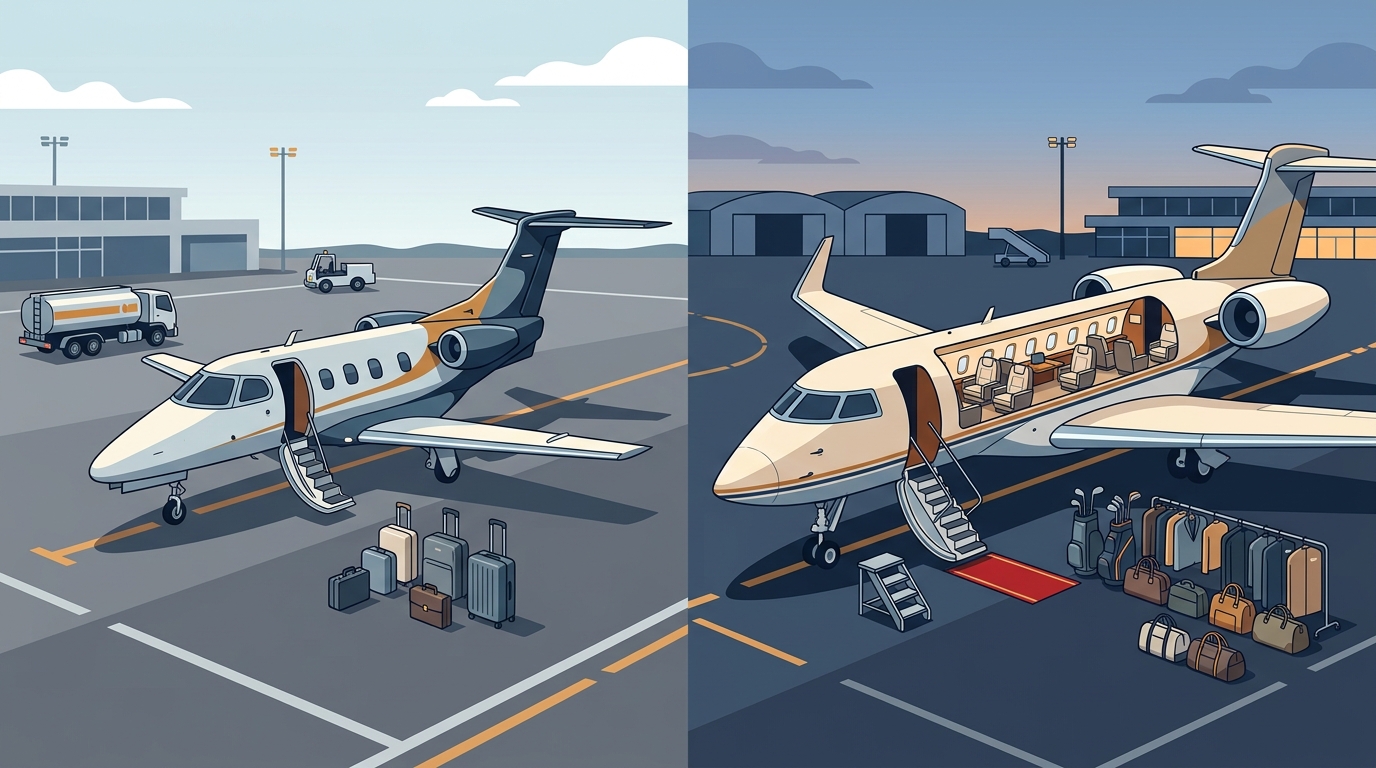
The private aviation market groups aircraft into distinct categories based on cabin size, range, and passenger capacity. Understanding these tiers is the foundation of every good selection decision.
Very Light Jets (VLJs)
VLJs seat four to five passengers and are built for short regional hops. They can typically fly 1,000–1,400 nautical miles nonstop, making them suitable for routes like New York to Atlanta or Dallas to Denver. Their compact size allows access to smaller regional airports with shorter runways.
Light Jets
Light jets comfortably carry five to seven passengers over ranges of roughly 1,200–2,000 nautical miles. They are the workhorse of short domestic travel — think city-to-city hops such as Boston to Washington, D.C. or Los Angeles to Phoenix. They are economical, fast, and can operate from smaller airfields that larger jets cannot access.
Midsize Jets
Midsize jets seat seven to nine passengers and extend range to approximately 2,000–2,600 nautical miles. With an enclosed lavatory, a stand-up cabin on many models, and more baggage space, they suit longer domestic routes like Chicago to Los Angeles or Atlanta to Denver without a fuel stop.
Super Midsize Jets
This category bridges the gap between midsize comfort and heavy-jet range. Super midsize jets accommodate up to nine or ten passengers and cover approximately 3,000–3,600 nautical miles nonstop — enough for coast-to-coast flights like Boston to Seattle. They are often the best-value tier for long domestic routes.
Heavy Jets
Heavy jets carry ten to fourteen passengers in spacious, multi-zone cabins with full galleys, flat beds, and premium entertainment. With ranges of 4,000–5,500 nautical miles, they handle demanding routes like New York to London or Los Angeles to Honolulu without refuelling.
Ultra-Long-Range Jets
The flagship tier seats up to fourteen to nineteen passengers and can fly 6,000–7,500+ nautical miles nonstop. Aircraft like the Gulfstream G700, Global 7500, and Falcon 8X enable intercontinental missions such as New York to Tokyo, Dallas to Dubai, or Los Angeles to Sydney with maximum cabin luxury.
Matching Jet Category to Route Distance
The simplest way to narrow your options is to start with distance. Below is a practical reference table:
| Route Distance | Example City Pairs | Recommended Category |
|---|---|---|
| Under 1,500 nm | New York–Miami, London–Geneva, LA–Phoenix | VLJ or Light Jet |
| 1,500–2,500 nm | Chicago–LA, New York–Denver, London–Istanbul | Midsize Jet |
| 2,500–3,600 nm | Boston–LA, New York–London, Miami–Bogotá | Super Midsize or Heavy Jet |
| 3,600–5,500 nm | Dallas–Paris, LA–Honolulu, Dubai–Tokyo | Heavy Jet |
| 5,500+ nm | New York–Tokyo, LA–Sydney, London–Singapore | Ultra-Long-Range Jet |
Keep in mind that published maximum ranges assume optimal conditions. Real-world factors — headwinds, passenger load, required fuel reserves, and air-traffic-control routing — can reduce effective range by 10–15 percent. Always build in a buffer when selecting your category.
Right-Sizing for Passenger Count and Luggage
Maximum seating capacity and comfortable seating capacity are two very different numbers. A light jet may list eight seats, but six passengers is often the realistic comfort threshold for flights longer than two hours. For trips over three hours, comfortable seating matters more than maximum seat count.
The Luggage Factor
Baggage is a frequently underestimated variable. Standard carry-on bags are manageable in any category, but bulky items — golf bags, skis, product samples, multiple large suitcases, strollers — push you into a higher category more often than passenger count does. Before booking, ask yourself whether this is a carry-on trip or a gear trip.
Quick Passenger-to-Category Guide
- 1–4 passengers, light luggage: VLJ or Light Jet
- 4–6 passengers, moderate luggage: Light or Midsize Jet
- 6–8 passengers or heavy luggage: Midsize or Super Midsize Jet
- 9–14 passengers: Heavy Jet
- 14+ passengers: Ultra-Long-Range Jet or VIP Airliner
Five Real-World Scenarios
Scenario 1: CEO Day-Trip — New York to Washington, D.C.
Distance: ~190 nm | Passengers: 2 | Best fit: Very Light Jet or Light Jet
This is a textbook short-hop mission. A VLJ like the Phenom 100 or a light jet like the Citation CJ3 handles it efficiently, can land at smaller airports like Teterboro or Reagan National, and keeps costs to a minimum.
Scenario 2: Sales Team Meeting — Chicago to Los Angeles
Distance: ~1,745 nm | Passengers: 6 with presentation equipment | Best fit: Midsize Jet
A midsize jet like the Hawker 800XP or Citation Latitude provides comfortable seating for six, a stand-up cabin for a working environment, and enough range to make this route nonstop. The enclosed lavatory is essential for a four-hour flight.
Scenario 3: Family Holiday — Miami to St. Barths
Distance: ~1,050 nm | Passengers: 5 adults, 2 children, heavy luggage | Best fit: Super Midsize Jet
While the distance suits a light jet, the luggage load for a family holiday — multiple large suitcases, beach gear, car seats — demands the baggage compartment of a super midsize. This is a classic example of luggage volume driving the category up.
Scenario 4: Board Retreat — New York to London
Distance: ~3,000 nm | Passengers: 10 | Best fit: Heavy Jet
Ten passengers crossing the Atlantic need a heavy jet like a Gulfstream G450 or Challenger 650. The cabin provides separate zones for working and resting, a full galley for catering, and enough range to make the crossing nonstop in most wind conditions.
Scenario 5: Global Investor Roadshow — Los Angeles to Tokyo
Distance: ~4,800 nm | Passengers: 8 | Best fit: Ultra-Long-Range Jet
Only ultra-long-range aircraft like the Global 7500 or Gulfstream G700 can cover this route nonstop. With separate compartments for meeting, dining, and sleeping, the cabin functions as a mobile office for an entire business day aloft.
Cost Considerations Beyond the Hourly Rate
The base hourly charter rate is just the starting point. A complete cost picture includes:
- Fuel surcharges — Variable based on jet fuel market prices
- Landing and handling fees — Vary widely by airport; major hubs charge more
- Crew overnight costs — Applicable if the crew needs to stay at your destination
- Catering — Light snacks versus full meal service at very different price points
- De-icing and seasonal surcharges — Winter operations add cost
- International fees — Overflight permits, customs, and immigration handling
A critical insight: a midsize jet that completes your route nonstop can be more economical overall than a light jet that requires a fuel stop, once you factor in the additional landing fees, fuel pricing at the stop, and the extra flight time.
Key Takeaways
- Start with distance. Your route length determines the minimum jet category. Build in a 10–15% range buffer for real-world conditions.
- Count passengers and luggage honestly. Comfortable capacity is always lower than maximum capacity, and heavy luggage pushes you up a category.
- Nonstop is a strategy, not a luxury. Avoiding fuel stops saves time, reduces risk, and can actually lower total trip cost.
- Match the cabin to the mission. A two-hour day-trip needs speed and efficiency; a seven-hour overnight needs sleep-capable seating and low cabin altitude.
- Look at total trip cost. Hourly rate alone is misleading — factor in fuel stops, repositioning, landing fees, and crew expenses.
- Consider airport access. Smaller jets unlock hundreds of additional airports, getting you closer to your actual destination.
Frequently Asked Questions
What size private jet do I need for 6 passengers?
For six passengers with standard luggage, a midsize jet is typically the best fit. It provides comfortable seating, an enclosed lavatory, and enough range for most domestic routes. If you are carrying heavy or bulky luggage, consider stepping up to a super midsize.
Can a light jet fly from New York to Los Angeles nonstop?
Generally no. Light jets have a range of roughly 1,200–2,000 nautical miles, while New York to Los Angeles is approximately 2,150 nautical miles. You would need a midsize or super midsize jet for this route nonstop. A light jet could make the trip with one fuel stop.
How do I decide between a super midsize and a heavy jet?
If your route is under 3,600 nautical miles and your group is nine or fewer, a super midsize jet usually offers the best balance of cost and comfort. Choose a heavy jet when you need true multi-zone cabin space, lie-flat sleeping capability, or the range for intercontinental missions beyond 3,600 nautical miles.
Does the number of passengers affect the range of a private jet?
Yes. Every additional passenger adds weight, which increases fuel consumption and reduces effective range. A jet advertised with a 3,500-nautical-mile range at light load may only achieve 3,100 nautical miles at full passenger and luggage capacity. Always discuss realistic range with your charter provider based on your specific load.
What is the most cost-effective jet category?
Light jets offer the lowest hourly rates and are the most cost-effective for short trips under 1,500 nautical miles with small groups. However, for longer routes, a midsize or super midsize jet that avoids a fuel stop can deliver a lower total trip cost than a cheaper-per-hour light jet that needs to refuel en route.
Should I always choose the smallest jet that fits my group?
Not necessarily. The smallest jet that technically fits your passenger count may not accommodate your luggage, may require a fuel stop on your route, or may lack adequate cabin comfort for the flight duration. The goal is to find the smallest jet that meets all your requirements — distance, passengers, luggage, and comfort — simultaneously.