

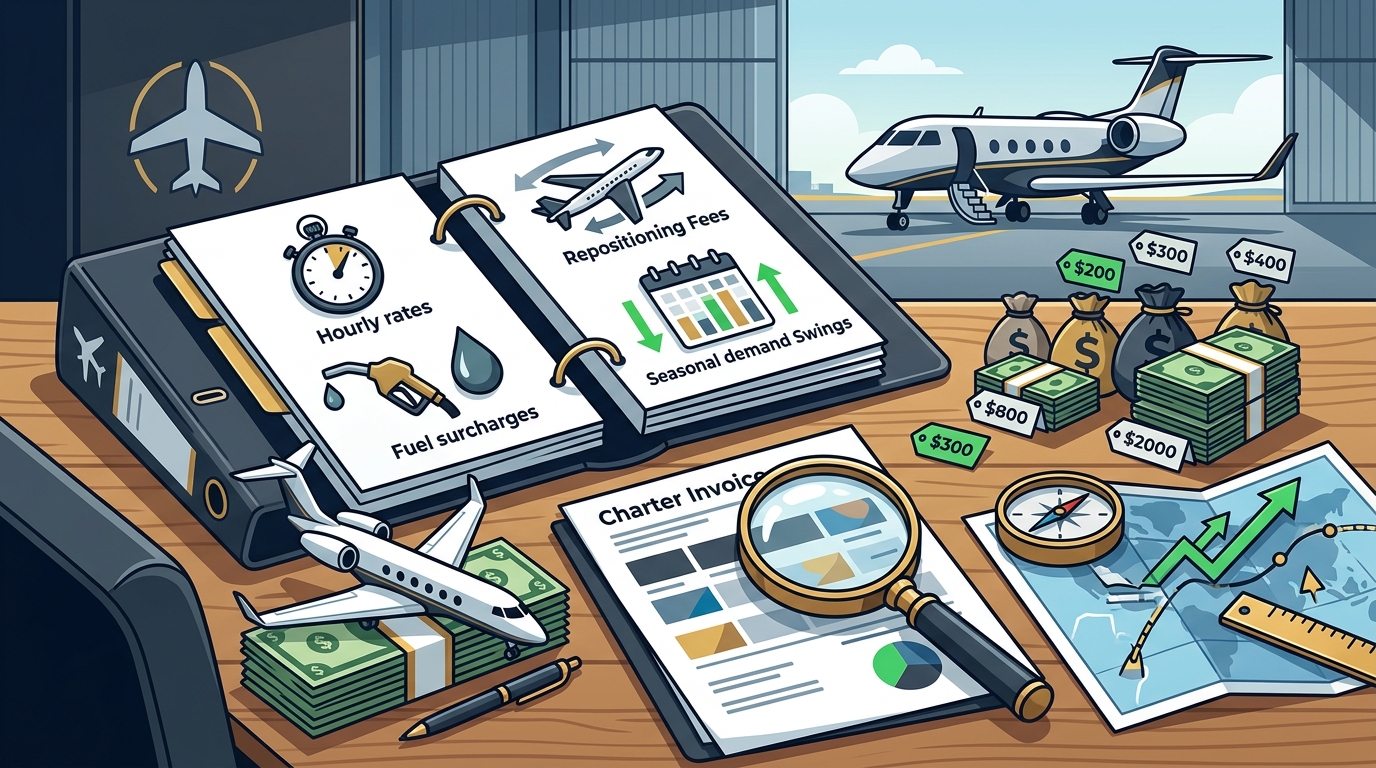
Private jet charter pricing is anything but transparent. Hourly rates, repositioning fees, fuel surcharges, and seasonal demand swings can turn a straightforward quote into a confusing spreadsheet. This guide walks you through proven, real-world strategies to secure the most competitive charter rates available—without sacrificing safety, comfort, or reliability.
Step 1: Understand What Actually Drives the Price
Before you can negotiate or comparison-shop effectively, you need to know the cost components that make up every charter invoice.
Hourly Aircraft Rates
The single biggest line item is the per-hour charge for the aircraft itself. In 2026, hourly rates span a wide range depending on jet category. Turboprops start around $2,000 per hour, light jets run $2,600–$3,500, midsize jets sit in the $4,000–$7,000 band, and heavy or ultra-long-range jets can exceed $15,000 per hour. At the very top end, VIP airliners may cost north of $30,000 per hour.
Fuel Surcharges
Fuel volatility directly impacts your final bill. As of early 2026, jet fuel averages approximately $3.99 per gallon—a roughly 60% spike—prompting most operators to apply a 10–15% variable surcharge on top of base rates. Always ask whether a quote includes or excludes fuel surcharges before comparing providers.
Repositioning (Deadhead) Fees
When the aircraft is not already stationed at your departure airport, it must fly empty to pick you up. That positioning leg is billed to you, either at the full hourly rate or as a flat fee. On a busy corridor this might add one to two extra flight hours to your invoice.
Landing, Handling, and Tax Fees
Airports charge landing fees that vary by aircraft weight and facility type. Major commercial airports like JFK or Miami International can charge over $1,000 per landing, while smaller executive airports may charge only $100–$500. Fixed-base operator (FBO) handling fees, overnight parking charges, and the 7.5% Federal Excise Tax on domestic US charters also apply.
Step 2: Collect and Compare Multiple Quotes
The charter market operates on dynamic pricing, so quotes from different operators for the same route and date can vary by 30% or more. Follow these principles when gathering quotes:
- Request at least three quotes from independent operators or brokers for every trip. Ensure each quote specifies the same aircraft category and includes identical line items.
- Demand all-inclusive pricing. A seemingly low base rate can balloon once fuel surcharges, FET, landing fees, and catering are added. The best brokers provide all-inclusive quotes at the time of booking so you face no surprises.
- Read the billing method. Some operators bill from engine start to engine shutdown, while others bill wheels-up to wheels-down. That distinction can shift the total by 15–20 minutes of flight time per leg.
Step 3: Target Empty Leg Flights
Empty leg flights—also called deadhead or repositioning flights—are one of the single best ways to slash charter costs. These occur when a jet must fly without passengers to reposition for its next booked charter or return to its home base.
Operators would rather sell these seats at a steep discount than fly completely empty. Savings of 50–75% off standard charter rates are common on empty legs. On popular corridors such as New York–Miami or Los Angeles–Las Vegas, empty legs are listed daily.
The trade-off is flexibility. Empty leg schedules are set by the primary booking, so departure times and sometimes even dates can shift on short notice. If your itinerary allows a window of a day or two, empty legs offer extraordinary value.
How to Find Empty Legs
- Register for empty-leg alerts with multiple brokers and operators—not just one.
- Monitor charter marketplace apps that aggregate empty legs from dozens of fleets.
- Work with a dedicated aviation advisor at a company like Zephyr Jets who can match your preferred routes to real-time empty-leg inventory.
Step 4: Use Date, Time, and Airport Flexibility
Flexibility is the most powerful cost lever available to charter clients. Three dimensions of flexibility matter most:
Travel Dates
Charter rates surge 20–40% above baseline during peak periods such as Thanksgiving, Christmas, New Year's, major sporting events like the Super Bowl, and cultural events like the Cannes Film Festival. Shifting your departure by even 24–48 hours around these windows can yield significant savings.
Departure Times
Early-morning or late-evening departures often cost less because demand clusters around mid-morning and late-afternoon slots. Being open to off-peak departure windows increases the likelihood of finding a better rate.
Airport Selection
Choosing a secondary airport over a primary hub can trim $1,000–$3,000 from your quote. In the New York area, for example, departing from White Plains (HPN) or Republic/Islip (ISP) instead of Teterboro (TEB) often lowers costs. In Los Angeles, Burbank (BUR) or Long Beach (LGB) tend to be cheaper alternatives to Van Nuys or LAX.
Step 5: Right-Size the Aircraft
Chartering a heavy jet when a light jet will do is the fastest way to overspend. Match the aircraft to the actual mission requirements:
| Mission Profile | Recommended Category | Approx. Hourly Rate (2026) |
|---|---|---|
| Short hops under 90 min, 4–6 pax | Turboprop (King Air 350) | $2,000–$3,000 |
| Regional flights up to 3 hrs, 6–8 pax | Light Jet (Citation CJ3+, Learjet 75) | $2,600–$4,500 |
| Cross-country US, 7–9 pax | Super-Midsize (Citation X, Challenger 350) | $5,000–$8,000 |
| Transcontinental or international, 10–14 pax | Heavy/Ultra-Long-Range (G450, Global 7500) | $10,000–$18,000+ |
If a fuel stop adds only 30–40 minutes to your trip, flying a midsize jet with one stop instead of a heavy jet nonstop can save $3,000–$5,000 per leg.
Step 6: Evaluate On-Demand vs. Jet Card vs. Membership
The way you purchase flight hours affects price predictability and total cost:
On-Demand Charter
You book individual trips as needed. This pay-as-you-fly model offers maximum flexibility in aircraft selection and routing and is ideal for travelers flying fewer than 25 hours per year. Pricing is dynamic—based on live market availability, aircraft position, and demand.
Jet Card Programs
Members pre-purchase blocks of flight hours at fixed, all-inclusive hourly rates. This eliminates the variability of on-demand pricing and often guarantees aircraft availability on short notice. Jet cards are best for travelers logging 25–100+ hours per year who value budget predictability.
Membership Programs
Some providers offer annual membership fees that unlock preferred rates, priority booking, and fleet guarantees. Before committing, calculate your expected annual hours. If you fly only occasionally, on-demand charters frequently beat the effective hourly cost of memberships that carry annual minimums.
Step 7: Leverage Brokers Who Make Operators Compete
The most effective brokers do not simply quote you a price from a single fleet. They submit your mission to multiple Part 135 operators simultaneously and let them compete for your trip, passing the savings directly to you.
When choosing a broker, verify the following:
- Safety certifications: The operators they source from should hold third-party safety audits such as ARGUS Platinum or Wyvern Wingman in addition to their FAA Part 135 Air Carrier Certificate.
- Transparent pricing: The broker should disclose their markup or fee structure. Reputable brokers either charge a disclosed flat fee or a transparent percentage rather than hiding margins inside inflated quotes.
- Zero-markup fuel policy: Some brokers pass fuel surcharges through at cost without adding their own margin, which can save hundreds to thousands of dollars per trip.
Step 8: Deploy Advanced Cost-Reduction Tactics
Book Two One-Ways Instead of a Round Trip
If you are staying at your destination overnight or for several days, booking two separate one-way charters is often cheaper than a round trip. A round-trip booking typically includes overnight fees for crew hotels and aircraft parking, which can add $2,000–$5,000 to the invoice.
Share the Charter
Because you pay for the entire aircraft regardless of how many seats are filled, splitting the cost with another party headed to the same destination dramatically reduces the per-person price. Shared or crowdfunded charter platforms now make it straightforward to find co-travelers.
Strip Unnecessary Extras
Gourmet catering, ground transportation arranged through the operator, and premium in-flight amenities all carry markups. If your flight is under three hours, consider a no-frills booking and arranging your own ground transport at the destination.
Book Early for Peak Periods
While last-minute flexibility helps on off-peak days, the opposite is true during high-demand periods. Booking 2–4 weeks in advance for peak dates secures better aircraft selection and avoids scarcity pricing.
Key Takeaways
- Understand every cost component—hourly rate, fuel surcharge, repositioning, landing fees, taxes—before comparing quotes.
- Collect at least three all-inclusive quotes from competing operators or brokers for every trip.
- Empty leg flights can save 50–75% if your schedule allows flexibility on dates and times.
- Airport, date, and time flexibility are free levers that routinely shave $1,000–$5,000 off a charter invoice.
- Right-size the aircraft to the mission; accepting a fuel stop can save thousands over upgrading to a larger jet.
- Evaluate on-demand vs. jet card pricing based on your annual flight hours, not marketing promises.
- Work with a broker who forces operators to compete for your trip rather than quoting a single fleet.
Frequently Asked Questions
What is the average cost to charter a private jet in 2026?
Hourly rates range from approximately $2,000 for a turboprop to over $15,000 for a heavy jet, with VIP airliners exceeding $30,000. Total trip cost depends on flight time, aircraft category, repositioning fees, and applicable taxes and surcharges.
How much can I save on an empty leg flight?
Empty leg flights typically offer savings of 50–75% compared to standard charter rates. They are most frequently available on high-traffic corridors like New York–Miami and Los Angeles–Las Vegas.
Is it cheaper to book a round trip or two one-way charters?
If you are staying at your destination overnight or longer, two one-way charters are often cheaper because you avoid crew overnight fees and aircraft parking charges that a round-trip booking includes.
How far in advance should I book a private jet charter?
For peak travel periods, booking 2–4 weeks ahead secures better pricing and aircraft selection. For off-peak travel, booking 5–7 days out still yields competitive rates, especially if you are flexible on aircraft type.
Do smaller airports really save money on charters?
Yes. Landing and handling fees at secondary airports can be $1,000–$3,000 less than at major hubs. Operators also face less congestion and shorter taxi times, which can reduce billable flight minutes.
What safety certifications should I look for in a charter operator?
At minimum, verify the operator holds an FAA Part 135 Air Carrier Certificate. Additionally, look for third-party safety audits from ARGUS Platinum or Wyvern Wingman, which evaluate maintenance records, pilot training, and operational history.